

Motorized shading should work as part of the room, not as an isolated feature. Bespoke motorized shading and drapery integration in Dubai brings blinds, curtains, tracks, motors, and controls together around a property’s windows and interior design. Depending on the selected equipment, the system can operate by remote, wall switch, or compatible smart-home platform.
A successful installation starts with precise measurements and choices suited to each window, treatment weight, power arrangement, and preferred control method. Compatibility between a motor and a wider automation system also depends on the motor model, control protocol, gateway, and platform. These details matter across villas, apartments, offices, and commercial interiors.
This guide explains how to assess windows, select bespoke blinds and drapery, plan motor and track installation, and configure controls for everyday use. It also covers decisions that shape integration across different property types, helping you understand the process before planning your project.
Key Takeaways
- Understand how motorized roller, Roman and sheer blinds differ from smart curtains, and why the treatment and motor need to suit each window.
- Choose between app, remote, wall-switch and voice control based on the system’s compatibility and how each room will be used.
- See how professional measurements, track selection, power planning and installation testing contribute to smooth operation.
- Explore how fabric, lining, glazing and window orientation affect light and heat control in Dubai homes and workspaces.
- Learn how to plan shading across villas, apartments, offices and commercial interiors, including as part of a renovation or fit-out.
What Are Motorized Blinds and Smart Curtains?
Motorized blinds and curtains use powered motors to move window treatments instead of requiring manual adjustment. In Dubai homes, the right choice depends on the window, desired light control, and how you want the system to operate.
Motorized Blind and Curtain Styles
Roller blinds use a single panel that travels around a tube, making them suitable for straightforward window coverage. Roman blinds fold into soft horizontal pleats as they rise, creating a more structured fabric finish. Sheer blinds and curtains filter daylight while maintaining a lighter appearance. Each style affects how much light enters and how the room feels.
Smart curtains move along a motorized track, while motorized blinds raise, lower, or adjust their coverings. For example, a living room might combine sheer curtains with a roller blind for flexible daylight control. The motor must suit the chosen treatment. Automated blinds can replace repeated manual adjustments, with an estimated 2-3 hours saved monthly.
Smart-Home and Building Automation Integration
Integration connects a blind or curtain motor to a wider control system. Compatibility between Somfy or Dooya motors and a smart-home platform depends on the motor model, control protocol, gateway, and automation platform. Some motors need an additional gateway or interface to communicate with other devices. These details determine whether window treatments can operate as part of a broader home or building automation setup.
Protocols such as Zigbee, Z-Wave, and Wi-Fi can support integration when the selected equipment is compatible. A professional maps the motor, controller, and platform before configuring operation. For example, an apartment system can group bedroom curtains separately from living-room blinds. This gives residents room-level control while keeping the smart-home setup coordinated.
Apartment Controls and Operation
Residents can operate compatible motorized curtains through a smartphone app, handheld remote, or wall-mounted switch. A remote or wall switch can operate curtains without Wi-Fi or internet access. With a compatible hub or smart-home controller, residents can also schedule opening and closing times. An astronomical clock can adjust sunset schedules as the seasons change.
Voice commands are available when the motor, control system, and voice platform work together. A resident might ask a compatible assistant to open the living-room curtains, then use a remote for a bedroom blind. Control choices should reflect how each room is used, not simply the number of devices. For blinds in Dubai apartments, coordinated control can also help manage daylight and indoor temperature through the day.
Smartphone app, remote, wall switch, and voice control
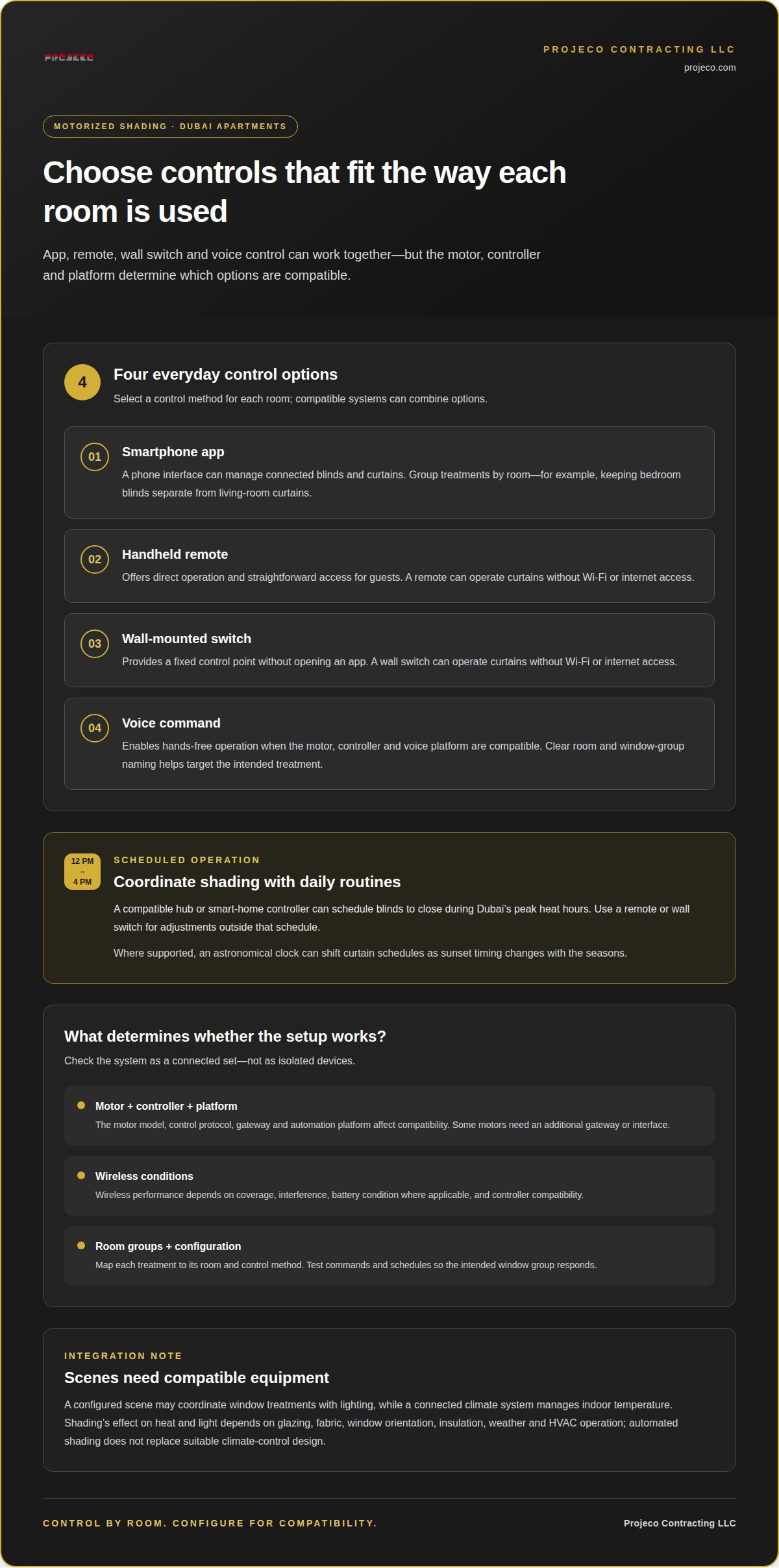
Control options shape how motorized shading fits daily life in Dubai apartments. A smartphone app can provide one interface for connected blinds and curtains, while a handheld remote offers direct operation. A wall switch provides a fixed control point without opening an app. The motor and controller determine which options work together.
Grouping treatments by room makes app operation more practical. For example, residents can keep bedroom blinds separate from living-room curtains instead of adjusting every window together. A remote offers straightforward access for guests, while an app can manage connected treatments. Wireless performance depends on coverage, interference, battery condition where applicable, and controller compatibility.
Voice control adds another option when the motor, controller, and voice platform are compatible. Residents might use a spoken command to open a living-room treatment, then make a finer adjustment with the app. The control system must identify the intended room or window group. Clear naming and configuration help prevent a command for one space from affecting another.
Scheduling can coordinate operation with routines. A compatible hub or smart-home controller can schedule blinds to close during Dubai’s 12 PM-4 PM peak heat hours. Residents can then use a remote or wall switch for adjustments outside that schedule. For curtains, an astronomical clock can shift sunset timing as seasons change, where the system supports that function.
Integration with lighting and climate controls depends on compatible equipment and configuration. A scene may coordinate window treatments with lighting, while a connected climate system manages indoor temperature. The treatment’s effect on heat and light depends on glazing, fabric, window orientation, insulation, weather, and HVAC operation. Automated shading can help manage solar heat, but it does not replace suitable climate-control design.
Control selection should match the apartment’s layout and residents’ habits. App access suits users who prefer a phone interface; a wall switch offers a permanent control point; voice commands support hands-free operation. During planning, the professional maps each treatment to its control method, checks compatibility, and tests commands and schedules. To plan controls alongside an apartment interior, discuss your apartment control requirements.
How professionals measure windows, select tracks, and install motors
Professional installation begins with assessing each window, its treatment, and available power. For bespoke curtains, the assessment records window dimensions, fabric weight, track position, and surrounding space. The installer also notes whether the system needs a fixed power connection or can use battery operation. These details inform track, motor, and control choices before fabrication or installation begins.
Measurements must account for how the treatment will move, not just the glass opening. A curtain needs room to travel along its track; a blind needs clearance to raise and lower without obstruction. The installer considers recess depth, nearby furniture, window handles, and intended fabric coverage. For a wide span, synchronized motors can help curtains move uniformly across the opening.
Motor and track selection depends on the treatment’s dimensions, weight, operating requirements, and control method. Heavy blackout curtains need a motor and track suited to their combined weight and size. Existing curtains require an assessment of the current track, curtain weight, dimensions, and suitable motor options. This helps prevent a mismatch that could lead to poor movement or premature wear.
Installation then covers mounting, power arrangements, control configuration, and operational testing. A standard residential motorized curtain or blind installation in Dubai typically takes 1-2 days. Testing includes movement, travel limits, controls, and configured scenes. Surge protection and thermal cutoff switches are recommended considerations for motorized curtain installations in Dubai; electrical arrangements should suit the property and system.
When choosing a motorized shading contractor in Dubai, compare the assessment process, measurement precision, motor and track selection, control compatibility, installation testing, and warranty terms. A clear scope should explain how the contractor handles existing tracks, power access, and final operation checks. These practical details help distinguish a complete installation from motor fitting alone.
For Dubai apartments, approval requirements depend on building management and installation scope. Work affecting shared areas or existing electrical infrastructure may require management review. The installation plan should identify mounting locations and power routes so the work can be coordinated with the property’s requirements.
A standard motorized blind warranty is 2 years. Maintenance can include inspecting motor housings, lubricating tracks, checking movement and mounting hardware, and updating firmware where applicable. Warranty coverage and after-sales support depend on the product and installation terms, so these should be documented as part of the project scope.
To prevent common installation and integration problems, the professional checks dimensions, treatment weight, track condition, power options, and controller compatibility before fitting. After installation, testing travel limits, controls, and scenes can reveal restricted movement or an unresponsive command before the system enters regular use.
Custom-made motorized blinds and material choices
Custom motorized treatments bring window dimensions, fabric, track, and controls into one coordinated specification. In Dubai, material selection should account for sunlight, heat, privacy, and interior design.
Blind Types and Motorization Options
Roller blinds provide a clean, single-panel profile, while Roman blinds create folded fabric layers. Sheer blinds soften daylight, and curtains add a separate fabric treatment along a track. Each option needs a compatible motor suited to its dimensions and weight. Not every motor supports every blind or curtain type, so treatment and motor selection should be considered together.
Motorized curtain tracks can be fitted to the ceiling or wall, according to the room layout. Their configuration should allow the curtain to travel freely and cover the intended window area. For example, a wide opening with heavy curtains needs a track and motor matched to the treatment, rather than a motor selected by appearance alone.
Styles, Fabrics, and Shading Choices
Dubai’s strong sunlight makes fabric, lining, glazing, window orientation, and treatment design important for controlling light and heat. Durable fabrics and corrosion-resistant tracks suit conditions involving high UV exposure, coastal humidity, and dust. In a bedroom, a lined curtain can support greater privacy; a sheer layer can filter daylight in a living space.
Fabric choice also shapes the finished interior, from the softness of a sheer curtain to the structured folds of a Roman blind. How much light and heat the treatment blocks depends on the combined window and treatment specification. A professional considers the room’s orientation and glazing alongside the desired privacy, then matches the fabric and lining accordingly.
Motorization affects how each treatment responds to commands. The motor must suit the blind or curtain type, its weight, and the track’s operating requirements. Controls can include a remote, app, or wall switch, provided the selected motor and controller are compatible. This pairing helps the treatment move as intended without asking a motor to operate an unsuitable fabric or track.
In Dubai, motorized blind costs depend on the number and size of windows, motor model, treatment type, power arrangement, control accessories, and integration requirements. The price depends on these specifications and is provided after a quote request. Comparing proposals is most useful when each describes the same window coverage, fabric or lining, motorization, power, and control scope.
For example, a sun-facing living-room window may need different fabric and lining from a bedroom where privacy is the priority. Matching those requirements to the blind or curtain style gives each space a considered finish and practical level of shading.
Motorized shading for villas, apartments, offices, and commercial spaces
There is no single system that suits every Dubai property. Wired motors can suit new villas and major renovations where power and control infrastructure can be planned in advance. Wireless systems may fit existing apartments where adding wiring is difficult. The right choice depends on the building, window dimensions, treatment weight, power access, and intended controls.
In a villa, the plan may coordinate large living-room windows, bedroom blackout curtains, and shared spaces. Wired systems can be considered during renovation, when infrastructure can be planned alongside finishes. For wide curtain spans, synchronized motors can help maintain uniform movement. Window orientation and glazing also inform how treatments manage daylight and solar heat.
Apartments often need solutions that work with the existing layout and wiring. Wireless motors may be suitable where new wiring would disrupt finished walls or ceilings. A room-by-room plan can keep bedroom blinds separate from living-area curtains. In Dubai high-rise homes, wind-resistant motors are described as handling gusts up to 60 km/h, a consideration for exposed windows.
In offices, specify operation around how people use each space. A meeting room may need coordinated treatments across several windows, while individual work areas may require separate controls. The design should account for window size, fabric, glare, and existing lighting or climate controls. These decisions connect shading performance to the way each office is used.
Commercial interiors also require attention to function and appearance. In a reception area, for example, a sheer treatment can soften daylight while preserving an open feel; a presentation room may call for blackout coverage. Track placement, treatment movement, and control grouping should suit the room’s layout and daily use, rather than applying one specification throughout the property.
Dubai’s heat makes solar control an important part of system planning. The World Health Organization says solar heat gain must be minimized through proper use of sunshades or external shading. Internal treatments can be selected alongside the building’s glazing and orientation, since fabric and window conditions affect how much light and heat enter. The result depends on the entire window arrangement, not motorization alone.
A practical specification starts by grouping windows according to their use, then matching each group to a treatment and power arrangement. The installer can map motor compatibility, track requirements, and control zones before fitting. During commissioning, the team tests movement in each room and confirms that grouped treatments operate as intended. This helps coordinate villas, apartments, offices, and commercial spaces without treating them as identical projects.
Planning a property-wide shading scheme? Discuss your motorized shading project.
Projeco Contracting LLC | Villa Construction | Apartment Interiors Fit Out
Projeco Contracting LLC | Villa Construction | Apartment Interiors Fit Out can coordinate motorized shading decisions within a wider residential project. This is useful when window treatments need to align with room layouts, finishes, power planning, and the overall interior scheme. Through residential interior and home renovation work, shading can be considered alongside the spaces it serves, rather than as an isolated addition.
For a villa renovation or fit-out, the project team can consider how curtains and blinds relate to window proportions, room use, and surrounding finishes. In apartments, the same integrated approach connects shading choices with the interior plan. Discussing the intended operation, treatment style, and project scope provides a clear starting point.
Contact Projeco Contracting LLC | Villa Construction | Apartment Interiors Fit Out to discuss your project.
Shape the next stage of your interior
Planning bespoke motorized shading and drapery integration in Dubai is an opportunity to bring window treatments into the wider vision for your property. Consider how each space should feel and function, then carry that direction into the interior decisions. A considered plan can align the desired atmosphere with the practical needs of daily living.
Projeco Contracting LLC | Villa Construction | Apartment Interiors Fit Out offers home renovation, residential interior, and villa renovation services. If shading is part of a broader renovation or interior project, these services provide a natural setting for coordinating window treatments with the property’s overall design. The next step is to discuss your space, priorities, and project scope.
Contact Projeco Contracting LLC | Villa Construction | Apartment Interiors Fit Out to discuss your plans and consider the right direction for your property.
Frequently Asked Questions
What is the difference between battery-powered and wired motorized curtains?
Battery-powered curtains avoid the need for a fixed power connection at the window, while wired systems use planned electrical power. The choice depends on the property’s existing infrastructure and renovation scope. For example, a finished apartment may suit a wireless arrangement where adding wiring is difficult, while a villa renovation can plan power routes as part of the wider work. Treatment size, weight, and control requirements also matter.
Can I set motorized curtains on a timer schedule in Dubai?
Yes, a compatible hub or smart-home controller can schedule motorized curtains to open or close at set times. An astronomical clock can adjust sunset schedules as the seasons change. For practical setup, decide which rooms should move together and whether each schedule follows a fixed time or sunset. A resident might schedule bedroom curtains separately from living-area treatments to suit different routines.
Can motorized curtains help with heat and energy management?
They can help manage solar exposure by closing window treatments when direct sunlight enters a room. This may support indoor temperature management and reduce reliance on air conditioning. The effect depends on glazing, fabric, window orientation, insulation, weather, and HVAC operation. For example, shading a sun-exposed room during the hottest part of the day can complement the property’s existing climate-control approach.
Can motorized curtains be retrofitted to existing curtain tracks?
Sometimes. A professional assesses the existing track, curtain weight, dimensions, and available motor options before planning a retrofit. The track must suit the treatment and allow the motor to move it as intended. This can be useful when residents want to retain existing curtains, but the track and curtain arrangement determine whether motorization is practical. The assessment also shows whether the existing setup needs adjustment.
Do motorized curtains require a WiFi connection to operate?
No. A handheld remote or wall-mounted push-button switch can operate motorized curtains without Wi-Fi or internet access. Smartphone control and wider smart-home integration use compatible controllers and equipment, so these functions are separate from basic local operation. For example, a resident can retain wall-switch control for everyday use while also integrating compatible curtains with a home automation system.
What affects installation cost?
Installation cost depends on the number and size of windows, motor model, treatment type, power arrangement, control accessories, and integration requirements. The project scope also matters, particularly when existing tracks or property infrastructure affect the work. Pricing is provided after a quote request. A useful request identifies the rooms, window coverage, preferred treatment, and desired controls to define the intended scope.
Which control method should you choose?
Choose controls according to who uses each room and how they prefer to operate its treatments. A wall switch offers a fixed point, while a handheld remote provides direct control from elsewhere in the room. An app suits connected systems and scheduled routines; voice commands require compatible equipment. In a shared home, keeping a physical control option can make operation straightforward for different residents.
What bespoke motorized shading and drapery integration services are available in Dubai?
Projeco Contracting LLC provides home renovation, residential interior, villa renovation, and villa fit-out services. For bespoke motorized shading and drapery integration in Dubai, discuss how the window-treatment plan relates to a wider residential project. The scope can be considered alongside interior design and renovation requirements, rather than as a separate design decision. This is a practical next step for homeowners planning coordinated property improvements.