

A shell-and-core space isn’t just a blank canvas; it’s a complex regulatory puzzle where a single documentation error in 2026 can trigger an immediate AI-driven rejection from the Building Permit System. For many Dubai leaders, the journey of an office fit out feels less like a creative transformation and more like a high-stakes race against shifting standards. You’ve likely felt the weight of choosing between a Category A or Category B setup, all while wondering if your fire safety plans will pass the increasingly rigorous Dubai Civil Defence inspections.
It’s natural to feel overwhelmed by the technicalities of DEWA approvals or the mandatory Al Sa’fat Green Building requirements. This guide provides the clarity you need to master every stage of the lifecycle, transforming your shell space into a high-performance corporate environment with precision and ease. We will explore the distinct fit-out categories, examine the latest 2026 regulatory updates, and reveal how a turnkey partner ensures your project remains on schedule and within your vision.
Key Takeaways
- Distinguish between Shell & Core, Category A, and Category B states to align your investment with your specific corporate requirements.
- Master the 2026 regulatory framework, including AI-assisted drawing checks and mandatory Al Sa’fat green building standards, to ensure a seamless office fit out.
- Explore modern design strategies that integrate hybrid-ready flexibility and biophilic elements to enhance employee wellness and operational performance.
- Secure a technical roadmap for navigating landlord NOCs and Dubai Civil Defence approvals to mitigate the risk of project delays and cost overruns.
- Understand the strategic value of a turnkey partner in delivering a bespoke, high-performance workspace through meticulous project management and white-glove execution.
What is an Office Fit Out? Defining the Transformation
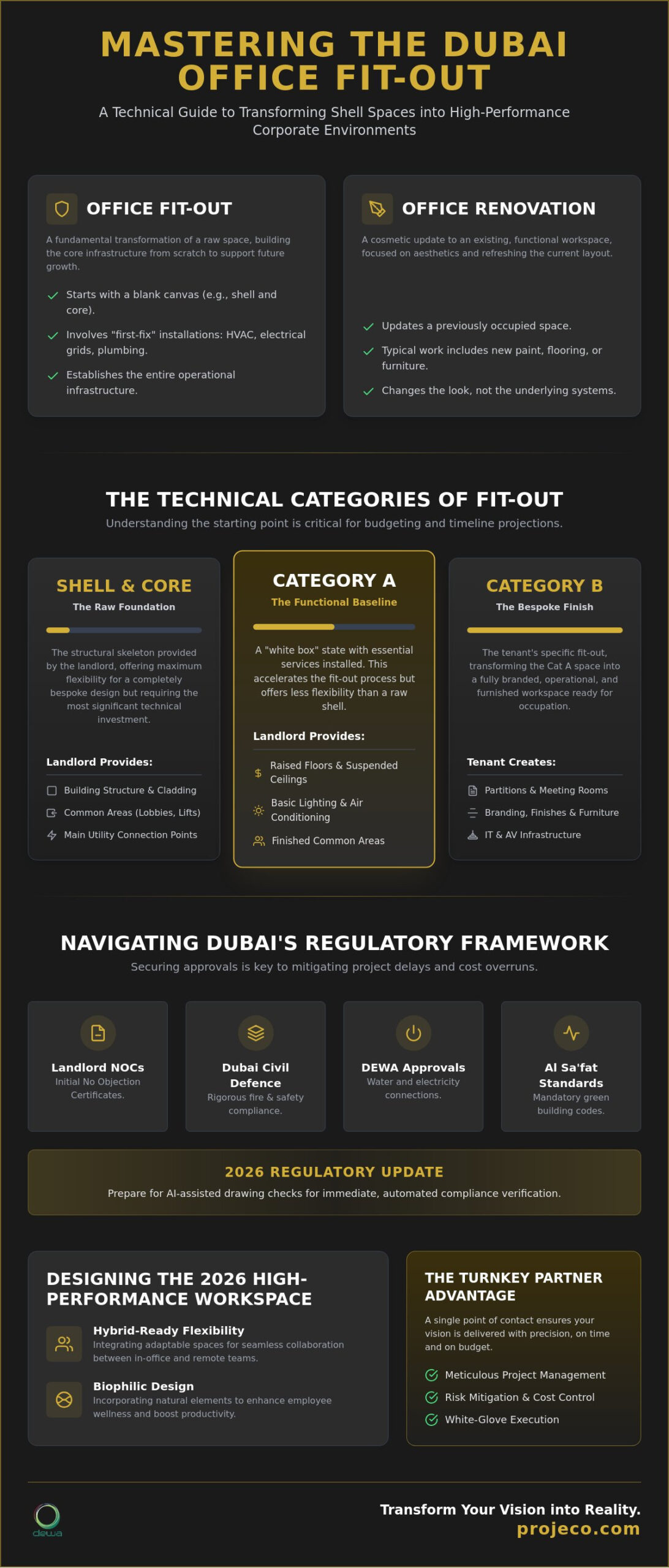
An office fit out represents the metamorphosis of a raw, industrial shell into a sophisticated corporate ecosystem. While a developer provides the structural skeleton, the fit out process injects the lifeblood: the power, the partitions, and the aesthetic soul that defines a brand. To understand the full scope of this transition, one must look at the technical definition of What is an Office Fit Out? which classifies the work as the essential bridge between construction and occupation. It’s the point where a building stops being a piece of real estate and starts being a business asset.
In Dubai’s competitive commercial market, the distinction between the landlord’s responsibility and the tenant’s vision is sharp. The landlord typically delivers a “cold” shell; the occupant then executes the office fit out to meet specific operational demands. This isn’t merely about aesthetics. It’s a rigorous technical undertaking that requires a deep understanding of structural integrity, mechanical systems, and local compliance standards. Every design choice must align with the practical realities of the building’s core infrastructure.
Fit Out vs. Office Renovation: The Key Differences
Renovations are cosmetic. Fit outs are fundamental. A renovation typically involves updating an existing, functional space by swapping carpets or repainting walls. In contrast, an office fit out begins with a blank canvas, often a bare concrete floor and exposed ceilings. This requires a different technical mindset because it involves “first-fix” installations. These include the complex routing of HVAC ducts, the placement of electrical grids, and the installation of fire suppression systems within a bare volume. You aren’t just changing the look; you’re building the infrastructure from scratch to support your future growth.
The Strategic Importance of a Professional Fit Out
The design of a workspace directly dictates the efficiency of the people within it. Poor space planning creates friction and slows communication. High-performance design eliminates these barriers. When you examine our portfolio of completed works, you see how technical discipline supports aesthetic luxury. A professional fit out acts as the bridge between a raw structural shell and a bespoke corporate headquarters. Beyond logistics, the psychological impact of a premium environment is a powerful tool for talent retention. A workspace that prioritizes employee wellness and ergonomic precision signals a commitment to quality that resonates with both staff and clients alike.
The Technical Categories: Shell & Core, Cat A, and Cat B
The starting point of your office fit out is rarely a matter of choice; it’s dictated by the specific lease terms and the architectural state of the building at handover. Understanding these technical categories is essential for accurate budgeting and timeline projections. Whether you’re inheriting a bare concrete volume or a functional white box, each category requires a distinct approach to engineering and design to ensure the final space meets your operational goals. Choosing the wrong starting point without a clear technical audit can lead to unforeseen costs during the infrastructure phase.
Shell and Core: The Raw Foundation
A shell and core handover is the most common scenario for new developments in prestigious districts like DIFC or Business Bay. In this state, the landlord provides the structural skeleton. Key elements typically include:
- External cladding and glazing
- Base building structural elements
- Basic common areas, such as lift lobbies and stairwells
- Main utility connection points
The tenant assumes the responsibility for installing all MEP (Mechanical, Electrical, and Plumbing) systems from these connection points. This provides maximum flexibility for a bespoke office fit out, but it demands a higher technical investment and a longer timeline to manage the foundational first-fixes. It’s the preferred choice for organizations that require highly specialized infrastructure or unique architectural features.
Category A: The Functional Baseline
Category A, or Cat A, serves as the landlord’s “white box.” It typically includes raised floors, suspended ceilings, and basic lighting and air conditioning. While this state allows a business to move in faster, it often lacks the soul of a premium brand. Many luxury-focused companies find Cat A restrictive because the existing infrastructure may not support high-end bespoke finishes or unconventional layouts without significant modification. It’s a functional baseline, but it’s rarely a final destination for a high-performance environment. Landlords use this category to attract tenants who want a “plug-and-play” feel, yet most premium occupiers will still need to strip back elements to achieve a truly custom feel.
Category B: The Bespoke Corporate Interior
Category B represents the final, polished stage of the process where a space becomes a working office. This is where we install partitions, private executive suites, and collaborative breakout zones. As noted in recent reports on Modern Trends in Office Design, the shift toward human-centric spaces is redefining what a “finished” office actually looks like. It integrates custom joinery, specialized IT infrastructure, and unique branding elements that reflect your corporate culture. To see how these technical categories translate into high-end environments, you can explore several Projeco projects that redefine the standard of excellence. Determining which category aligns with your lease and vision is a critical first step, and our team is available to discuss your specific site requirements.
The Dubai Fit Out Process: Navigating Approvals and Execution
Executing a premium office fit out in Dubai requires more than just architectural vision; it demands a meticulous mastery of the city’s regulatory landscape. The journey doesn’t begin with the first hammer strike, but with the securing of No Objection Certificates (NOCs) from the landlord or building developer. This initial step confirms that your proposed structural changes and MEP layouts don’t compromise the building’s integrity or shared services. Without this foundational approval, your project cannot legally proceed to the official permit stage.
Once the landlord provides clearance, the focus shifts to the Dubai Civil Defence (DCD) and DEWA. Fire safety compliance is non-negotiable, and the DCD approval process typically spans between 7 and 30 working days depending on project complexity. In 2026, the introduction of AI-assisted drawing checks means that even minor discrepancies in documentation can lead to immediate rejection. To mitigate delays, some firms utilize the express inspection option for an AED 1,000 fee, which can confirm site inspections within 7 working days. Simultaneously, your team must coordinate with DEWA to manage electrical load increments, ensuring your high-performance workspace has the power density required for modern IT infrastructure.
The Design and Build Advantage in Dubai
Fragmenting your project between separate designers and contractors often creates friction during the approval phase. Choosing a design & build model consolidates accountability into a single point of contact. At Projeco, we manage the intricate coordination between our architects and MEP engineers from day one. This integrated approach ensures that every creative choice is pre-vetted for regulatory compliance, significantly reducing the risk of costly redesigns or permit rejections. It’s about maintaining a steady, quality-focused delivery while we handle the complexities of the submission portals on your behalf.
Essential Regulatory Bodies and Permits
The specific jurisdiction of your office dictates which regulatory body holds authority. While Dubai Municipality oversees most commercial zones, developments within free zones often fall under the scrutiny of Trakhees. Each entity has its own set of technical standards and mandatory inspections. A sophisticated office fit out contractor is essential for securing the final ‘Completion Certificate,’ which officially permits you to occupy the space. Professional permit management is as vital as the physical construction in Dubai. For those concurrently navigating the complexities of company formation, vostokconsult.ae offers specialized expertise in establishing a legal presence in the UAE. By navigating these bureaucratic hurdles with precision, we ensure your transition from a raw shell to a bespoke headquarters is seamless and on schedule.
Modern Trends: Designing the 2026 High-Performance Workspace
Biophilic design has also matured from a decorative trend into a pillar of employee wellness. It’s an evidence-based strategy that uses natural light, indoor greenery, and organic materials like stone and wood to reduce cortisol levels and boost cognitive function. For a deeper understanding of how these principles are reshaping workplaces across the emirate, our comprehensive guide to office interior design Dubai trends and strategies for 2026 explores the full spectrum of emerging approaches. This human-centric approach is vital for businesses seeking to maximize the ROI of their physical footprint. By prioritizing air quality and ergonomic precision, firms can create an environment that actively supports the health of their most valuable asset: their people.
The Rise of the ‘Destination Office’
To compete with the comfort of home, the modern office must offer an experience that is impossible to replicate remotely. We call this the ‘Destination Office.’ It incorporates high-end F&B elements, such as bespoke coffee bars and luxury corporate lounges, that mirror the hospitality of a five-star hotel. Utilizing premium materials like Calacatta marble and custom-engineered joinery doesn’t just signal brand prestige; it creates a tactile sense of quality that reinforces a company’s culture and values. Employees don’t just visit these spaces because they have to; they visit because the environment inspires their best work.
Acoustics and Privacy in Open-Plan Layouts
While collaboration is a primary goal, the need for confidentiality remains paramount, particularly within Dubai’s thriving legal and financial sectors. Modern open-plan designs must balance transparency with technical acoustic discipline. This involves the strategic installation of specialized double-glazed glass partitions and acoustic wall panels that dampen ambient noise without sacrificing natural light. Integrating ‘focus pods’ alongside vibrant collaborative zones ensures that employees have the quietude required for deep work. If you’re ready to elevate your corporate environment with these advanced strategies, you can consult with our design specialists today to begin your transformation.
Choosing Your Partner: Projeco’s Turnkey Fit Out Excellence
The successful execution of a premium office fit out is defined by the seamless fusion of architectural imagination and technical discipline. At Projeco, we operate as a complete solution provider, bridging the gap between a visionary design concept and a fully operational corporate headquarters. Our philosophy centers on an unwavering commitment to high standards, where meticulous attention to detail in premium joinery and bespoke finishes isn’t just a goal; it’s our standard. We understand that for elite firms, the workspace is a physical manifestation of brand prestige, requiring a level of craftsmanship that only a seasoned professional can deliver.
Our comprehensive project management covers every phase of the lifecycle. We begin with a rigorous shell assessment to identify potential infrastructure challenges before they become costly delays. This proactive approach continues through to the final white-glove handover, ensuring that every element of the interior reflects the precision your business demands. Our extensive experience in commercial fit out Dubai has positioned us as the preferred partner for organizations that refuse to compromise on quality or timeline. We take pride in a methodical process that manages complexity with ease, allowing you to witness the transformation of your space without the burden of technical coordination.
Our Integrated Design and Build Methodology
Traditional project models often suffer from a fragmented approach that leads to friction between designers and contractors. We eliminate this through an integrated design and build methodology. By consolidating accountability, we offer transparent budgeting and milestone-based tracking that keeps you informed at every stage of the construction. Whether your project is located on Sheikh Zayed Road or within the prime business districts of Downtown Dubai, our team ensures a steady, quality-focused delivery. This structured rhythm mirrors the organized nature of a complex project, ensuring that your vision remains intact from the first render to the final inspection.
Next Steps: Embarking on Your Office Transformation
The journey toward a high-performance environment begins with an initial consultation to assess your specific space and operational requirements. We don’t believe in generic solutions. Instead, we develop a bespoke design concept that captures your corporate vision while adhering to the technical realities of Dubai’s regulatory environment. It’s time to transform your shell space into a sanctuary of productivity and prestige. Connect with Projeco for a consultation on your next office fit out and discover the difference that professional authority and refined craftsmanship can make to your corporate footprint.
Elevate Your Dubai Corporate Footprint
Navigating a premium office fit out in Dubai’s evolving 2026 landscape requires more than just an eye for design. It demands a technical mastery of regulatory standards and a strategic understanding of how space influences human performance. You’ve seen how the distinction between technical categories and the integration of smart, sustainable technologies can redefine a corporate environment. Success lies in the meticulous coordination of every moving part, from the initial shell assessment to the final issuance of a completion certificate.
Choosing a partner who balances aesthetic luxury with engineering discipline ensures your project avoids the common pitfalls of delays and compliance rejections. Projeco brings deep Dubai-based expertise in high-end commercial interiors and a seamless design and build model that manages every regulatory hurdle on your behalf. We provide turnkey project management that transforms raw potential into a bespoke headquarters. Your vision deserves the precision of a refined craftsman and the visionary discipline of a seasoned professional.
Transform your workspace with Projeco’s elite design and build services
Frequently Asked Questions
How long does a standard office fit out take in Dubai?
A standard project typically spans 8 to 14 weeks depending on the scale and complexity of the interior design. This timeline includes the initial design phase, the 7 to 30 working days required for Dubai Civil Defence approvals, and the physical construction. Large-scale corporate headquarters or those requiring specialized technical infrastructure may require a longer duration to ensure meticulous execution.
What is the difference between a Cat A and a Cat B fit out?
A Category A fit out provides a functional baseline with raised floors and suspended ceilings, while a Category B fit out delivers a bespoke, move-in-ready environment. The latter integrates your specific branding, private executive suites, and collaborative zones tailored to your workflow. Most premium occupiers choose Category B to ensure the office fit out reflects their unique corporate identity and operational needs.
Do I need DCD approval for a minor office renovation?
Yes, any modification that impacts the fire safety layout or sprinkler system requires Dubai Civil Defence approval. Even minor structural changes to partitions can alter smoke detection coverage and fire exit paths. Securing these permits is mandatory to avoid significant penalties and to ensure the safety of all occupants within the building.
What are the typical costs associated with an office fit out in Dubai?
Costs are primarily influenced by the choice of materials, the complexity of MEP infrastructure, and the specific regulatory zone of the property. Premium finishes and advanced smart office technology require a different investment level than a basic white-box setup. We recommend a detailed site audit to establish a precise budget that aligns with your specific corporate vision and quality standards.
Can Projeco manage the entire approval process with DEWA and the landlord?
Projeco operates as a complete solution provider, managing every interaction with landlords, DEWA, and Dubai Municipality. Our team handles the submission of technical drawings and the acquisition of No Objection Certificates on your behalf. This integrated approach ensures your project remains compliant with all 2026 standards without requiring your direct involvement in complex bureaucratic hurdles.
What is a ‘white box’ office space?
A ‘white box’ space is another term for a Category A handover where the landlord provides a basic, functional interior. It typically includes white-painted walls, basic lighting, and essential HVAC systems already in place. This state serves as a blank canvas for tenants who wish to implement their own bespoke Category B design and branding.
How does the design and build model save time on office projects?
The design and build model overlaps the design and permitting phases to eliminate the communication gaps found in traditional procurement. By housing architects and contractors under one roof, we can begin long-lead procurement while approvals are still in progress. This streamlined rhythm prevents project delays and keeps the execution timeline steady and deliberate.
Is it possible to stay in our office during a phased fit out?
Yes, phased execution allows a business to remain operational by dividing the project into distinct, manageable zones. This approach requires meticulous scheduling and acoustic management to minimize disruption to your daily workflow. It’s a practical solution for large organizations that cannot facilitate a total temporary relocation during the transformation.