

Choosing the lowest initial bid for your restaurant fit out cost Dubai might actually be the most expensive mistake you’ll make in 2026. In a market defined by uncompromising luxury and rigorous regulatory standards, the cheapest path often leads to a labyrinth of variation orders and delayed openings. You’re likely well aware that launching a successful F&B venue requires more than just a beautiful menu. It demands a flawless execution of space that satisfies both the Dubai Municipality and your most discerning guests. Balancing these technical requirements with high-end aesthetics is a complex challenge that keeps even veteran restaurateurs on edge.
This guide promises to demystify that complexity by providing a clear, strategic framework for your investment. You’ll learn how to master the financial landscape of Dubai’s F&B sector with current market benchmarks and a deep dive into often-overlooked compliance expenses. We’ll provide a comprehensive AED per square foot analysis and reveal exactly where to allocate your budget for maximum impact. By the end of this article, you’ll have the confidence to choose a turnkey partner who can transform your vision into a high-performing, compliant reality without the fear of hidden costs.
Key Takeaways
- Establish a realistic baseline for your 2026 project by understanding the current market tiers for shell-and-core versus premium luxury spaces.
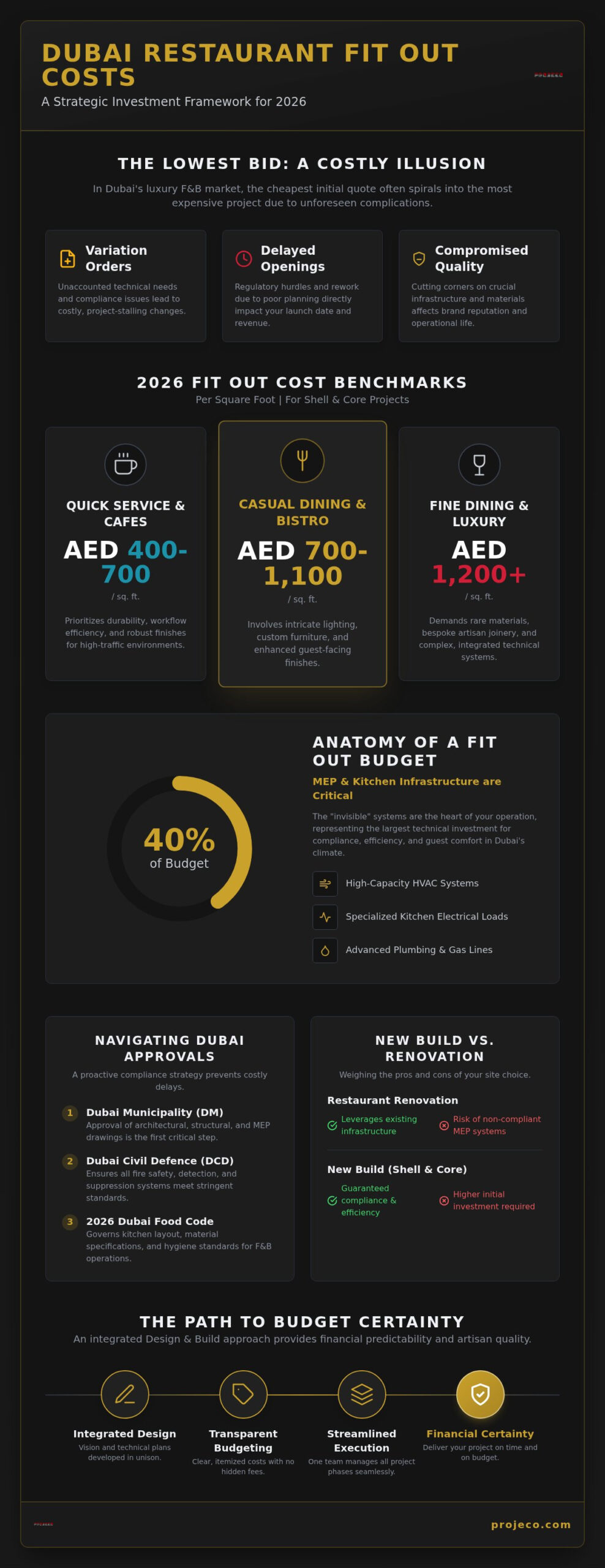
- Identify why MEP and kitchen infrastructure represent nearly 40% of your total budget and learn how to manage these critical variables effectively.
- Navigate the mandatory Dubai Municipality and Civil Defence approval processes with a checklist designed to prevent costly delays and variation orders.
- Master the strategic factors that define the restaurant fit out cost Dubai through a clear, data-driven per-square-foot framework.
- Discover how an integrated Design & Build approach provides financial certainty while maintaining the artisan craftsmanship required for high-end F&B venues.
Average Restaurant Fit Out Cost in Dubai: 2026 Market Benchmarks
Dubai’s F&B sector has matured into a global epicenter for hospitality innovation. In 2026, the market is defined by a sophisticated consumer base that demands immersive dining experiences and impeccable design. Consequently, calculating a realistic restaurant fit out cost Dubai requires a granular understanding of current economic drivers. Material supply chains have stabilized, yet the demand for highly skilled artisan labor has increased, driving the Primary Cost Drivers toward the higher end of the spectrum. Most commercial spaces are handed over in a shell and core state. This means you are essentially inheriting a concrete box that requires a complete technical and aesthetic transformation to become a functional venue.
The financial landscape for 2026 reflects a greater emphasis on integrated technology and sustainable materials. Investors must account for these advancements when establishing their initial budgets. A professional fit-out is not merely an expense; it is a strategic asset that dictates the operational efficiency and longevity of your brand. You can examine the execution of these standards in our portfolio of completed luxury projects across the city.
Tiered Pricing Framework for 2026
Cost expectations vary significantly depending on the concept’s complexity and the level of bespoke detailing involved. For a professional, high-standard execution in 2026, the following benchmarks apply:
- Quick Service & Cafes: AED 400 to AED 700 per sq. ft. These projects prioritize durability and workflow efficiency within a smaller footprint.
- Casual Dining & Bistro: AED 700 to AED 1,100 per sq. ft. This tier involves more intricate lighting schemes and customized furniture solutions.
- Fine Dining & Luxury Venues: AED 1,200 to AED 2,000+ per sq. ft. These venues demand rare materials, artisan joinery, and complex MEP configurations.
New Build vs. Restaurant Renovation Costs
Acquiring an existing F&B site can offer a head start, particularly if the previous tenant left behind usable gas lines or grease traps. This often reduces the initial restaurant fit out cost Dubai by leveraging existing infrastructure. However, these savings can be deceptive. Older MEP systems frequently fail to meet the 2026 Dubai Food Code requirements, leading to expensive remediation work. A complete brand transformation requires more than a fresh coat of paint. It often involves structural modifications to accommodate modern kitchen equipment or to improve the guest flow. While a cosmetic update is faster, a comprehensive renovation ensures your facility is compliant and operationally sound for years to come.
The Anatomy of an F&B Budget: Primary Cost Drivers
The true complexity of a hospitality project lies beneath its surface. While the front-of-house aesthetics capture the guest’s attention, the mechanical, electrical, and plumbing (MEP) systems act as the venue’s vital organs. In 2026, these “invisible” elements often account for up to 40% of the total restaurant fit out cost Dubai. This high percentage is driven by the rigorous technical demands of modern F&B operations and the necessity for flawless integration with existing building services. Understanding these foundational expenses is critical for maintaining budget certainty from the outset. You can see how we balance these technical requirements with high-end design in our recent F&B portfolio.
Global supply chain fluctuations continue to influence materiality and procurement strategies. Sourcing premium finishes requires a proactive approach to logistics to avoid inflationary spikes. Beyond materials, the procedural requirements for construction in the UAE are highly structured. According to the 2026 Market Benchmarks for construction permits, the precision of your initial technical drawings directly impacts your approval timeline and, consequently, your carrying costs.
MEP and Technical Infrastructure
Precision in technical engineering is non-negotiable. Dubai’s climate necessitates high-capacity HVAC systems that can maintain guest comfort during peak summer months while managing the intense heat output of a commercial kitchen. Key technical drivers include:
- HVAC Capacity: Calculating the precise cooling load to balance ambient temperatures with kitchen exhaust requirements.
- Electrical Load Management: Ensuring the site’s power allocation can support heavy-duty ovens, refrigeration suites, and sophisticated lighting arrays.
- Life Safety Systems: Integrating Civil Defence-approved fire suppression and smoke extraction systems that meet the latest 2026 safety codes.
Kitchen and Back-of-House Solutions
The back-of-house is the engine of your restaurant. Custom stainless steel fabrication is often required to maximize workflow efficiency in compact urban footprints. Investing in industrial-grade appliances is a strategic choice; while the initial cost is higher than standard units, their durability prevents operational downtime. On average, the kitchen and back-of-house infrastructure typically consume between 25% and 35% of the total project budget.
Lighting design also plays a pivotal role in luxury F&B, transitioning from a functional necessity to an architectural feature. Sophisticated dimming systems and bespoke fixtures add layers of prestige but require dedicated electrical planning. If you’re ready to define the specific technical requirements for your venue, it’s wise to consult with an expert who understands the nuances of the Dubai market.
Luxury vs. Standard: Why Materiality and Joinery Dictate the Price
In Dubai’s competitive F&B market, the distinction between a standard eatery and a luxury destination is often measured by the quality of the tactile environment. A luxury fit-out transcends the mere selection of expensive materials; it represents a commitment to precision and narrative through design. This tier typically commands a higher restaurant fit out cost Dubai because it prioritizes longevity and exclusivity over off-the-shelf solutions. Every surface, from the grain of the wood to the weight of the door handles, communicates a brand’s prestige to its guests.
Central to this elevation is the role of Artisan Craftsmanship. Bespoke joinery acts as the architectural anchor of the space. While locally fabricated finishes offer speed and cost-efficiency, imported specialized materials provide a unique aesthetic signature that distinguishes a venue in a crowded market. The decision to invest in artisan-led execution ensures that the venue doesn’t just look impressive on opening night but remains a durable asset for years to come.
Bespoke Joinery and Custom Finishes
Custom-built bars, intricate host stands, and tailored banquette seating are the primary drivers of cost in high-end projects. These elements are designed to withstand the high-traffic demands of a commercial environment while maintaining a residential level of comfort and finish. Luxury stones like book-matched marble or specialized hand-applied wall textures command a premium due to the skilled labor required for installation. Investing in superior materiality reduces future maintenance costs and preserves the venue’s overall value, ensuring a better return on investment over time.
Aesthetic Luxury and Functional Design
Modern restaurateurs often face the challenge of balancing “Instagrammable” aesthetics with commercial-grade durability. A space must be visually arresting yet capable of performing under pressure. This includes technical considerations like acoustic treatments, which are vital in high-ceilinged Dubai venues to ensure guest conversations remain private and comfortable. The standards for these spaces often mirror the precision found in Bespoke Villa Interior Design, where every detail is scrutinized for both beauty and function. You can view examples of this balance in our collection of premium F&B spaces.
Compliance and Hidden Costs: Navigating Dubai Approvals
The regulatory landscape is often the most underestimated component of the restaurant fit out cost Dubai. While aesthetics and kitchen equipment are tangible, the procedural requirements of Dubai’s various authorities dictate the project’s actual timeline and financial health. Navigating these approvals requires a meticulous approach to ensure that your venue meets the stringent standards of the Dubai Municipality (DM) and the Dubai Civil Defence (DCD). Failure to account for these steps early in the planning phase can lead to significant delays and unbudgeted variation orders that erode your capital reserves.
Location significantly influences your compliance budget. Operating on the mainland involves different fee structures and approval pathways than those found in specialized zones like the Dubai Design District (D3) or the Dubai International Financial Centre (DIFC), which can impact the final restaurant fit out cost Dubai. Freezone authorities, such as Tecom or Concordia, often have their own specific fit-out manuals and third-party inspection requirements. These nuances contribute to the “hidden” costs of a project, which also include contractor insurance, building management security deposits, and mandatory structural stability certificates. You can see how we manage these complex compliance requirements in our portfolio of high-profile venues.
Mandatory Approval Fees and Timelines
Securing utility connections is a primary milestone. DEWA (Dubai Electricity and Water Authority) connection fees and load increments are calculated based on your kitchen’s power demand, which we discussed in the MEP analysis. Utilizing professional PRO services is a strategic investment to expedite permit handling and ensure that technical drawings are submitted correctly the first time. You should always maintain an approval contingency fund representing 5% to 10% of your total budget to cover unforeseen regulatory adjustments or minor site modifications required by inspectors.
Compliance with Health and Safety Standards
Health and safety regulations are non-negotiable in the F&B industry. HACCP (Hazard Analysis and Critical Control Point) compliance must be integrated into the kitchen’s architectural layout to ensure proper food flow and hygiene. This involves specific costs for:
- Waste Management: Installation of specialized grease traps and dedicated waste disposal systems as per DM guidelines.
- Accessibility: Ensuring ADA compliance in restaurant layouts, including ramps and accessible washroom facilities.
- Fire Safety: Rigorous DCD inspections of smoke detectors, sprinklers, and fire-rated materials.
Managing these multifaceted requirements demands an experienced partner who can anticipate hurdles before they impact your bottom line. If you’re ready to secure your project’s regulatory path, book a compliance consultation with our expert team today.
The Projeco Advantage: Turnkey Design & Build for Budget Control
Traditional procurement methods often separate the visionary designer from the technical contractor. This fragmentation is frequently the root cause of budget drift and project delays. In the context of a restaurant fit out cost Dubai, where technical compliance and aesthetic precision must coexist, a unified Design & Build model is the most effective safeguard for your capital. By consolidating accountability under a single entity, you eliminate the “hidden variations” that typically arise when a contractor discovers that a conceptual design is technically unfeasible or exceeds the allocated power load.
Value engineering is another cornerstone of our approach. This process doesn’t involve compromising on the luxury standards we’ve discussed; rather, it focuses on strategic procurement and intelligent material selection. We analyze the 2026 market to identify high-performance alternatives that maintain the desired visual impact while optimizing the project’s financial footprint. This proactive management ensures that the final execution costs align perfectly with the initial conceptual budget, providing you with a predictable path to operational readiness.
Eliminating the “Contractor vs. Designer” Conflict
A single point of accountability fundamentally changes the project dynamic. There is no finger-pointing when technical challenges arise. Our team provides real-time cost feedback during the earliest design phases, which prevents the over-scoping that often leads to painful budget cuts later in the project. This integrated workflow accelerates the transition from a shell and core site to a revenue-generating venue. You can witness the results of this streamlined methodology in our Projeco Projects Portfolio, where complex F&B visions are realized with surgical precision.
Maximizing ROI in the Dubai F&B Market
The return on investment for a luxury venue is heavily influenced by its time-to-market. Every week lost to miscommunication or approval delays represents wasted rent and lost revenue. We mitigate these risks by leveraging our deep familiarity with Dubai’s regulatory landscape and our in-house technical expertise. Beyond the opening night, we focus on the long-term operational costs of your facility. This includes selecting materials that resist the wear of high-traffic commercial environments and providing robust post-construction support. If you’re ready to move beyond estimates and secure a definitive budget for your vision, Consult Projeco for a detailed F&B fit-out feasibility study to ensure your project’s success from the first drawing.
Securing Your Vision in Dubai’s 2026 F&B Landscape
Success in the city’s competitive dining scene requires more than a culinary concept. It demands a sophisticated understanding of the financial and technical foundations that support a luxury venue. By mastering the restaurant fit out cost Dubai, you position your investment for long-term stability rather than short-term compromise. We’ve explored the critical importance of technical MEP infrastructure, the prestige of artisan joinery, and the necessity of navigating complex municipal approvals with precision. These elements aren’t separate expenses but integrated components of a high-performing business asset.
Choosing a partner who offers seamless turnkey project management is the most effective way to eliminate budget fragmentation. Projeco acts as your authoritative expert and refined craftsman, providing the expert F&B fit-out and decoration solutions required to transform shell and core spaces into world-class destinations. As luxury design and build specialists, our integrated approach ensures your vision is executed with unwavering reliability and aesthetic excellence. We invite you to Request a Bespoke F&B Fit-Out Consultation with Projeco to begin defining your project’s path to success. With the right strategic framework, your venue will set a new benchmark for excellence in the Dubai market.
Frequently Asked Questions
What is the average cost per square foot for a restaurant fit-out in Dubai in 2026?
The average restaurant fit out cost Dubai in 2026 typically spans from AED 400 per square foot for quick-service cafes to over AED 2,000 for ultra-luxury fine dining venues. These benchmarks reflect current material inflation and the rising demand for high-capacity technical systems. Your final investment depends on the complexity of the bespoke joinery and the specific utility load requirements of your kitchen infrastructure.
How long does a typical restaurant fit-out take from design to handover?
A typical project of 1,500 to 3,000 square feet generally requires 8 to 12 weeks from the final design approval to the official handover. This timeline includes the procurement of specialized finishes and the mandatory inspection periods required by Dubai authorities. Complex luxury venues involving extensive artisan craftsmanship may extend this duration to ensure every detail meets our high standards of precision and quality.
Are kitchen equipment costs included in the fit-out AED per sq. ft. estimates?
Standard fit-out benchmarks often exclude industrial-grade kitchen appliances, which are treated as a separate capital investment. While the fit-out covers the essential infrastructure like gas lines, ventilation, and grease traps, the specialized cooking suites and refrigeration units are budgeted independently. It’s essential to integrate these technical requirements into your initial design to avoid costly modifications during the construction phase of your venue.
What are the main Dubai authorities that must approve an F&B fit-out?
Every F&B project requires approvals from the Dubai Municipality (DM) for health and safety and the Dubai Civil Defence (DCD) for fire safety. Additionally, the Dubai Electricity and Water Authority (DEWA) must approve your utility load and connections. Depending on your location, you may also need clearances from zone-specific entities such as the DIFC, Tecom, or the Dubai Design District (D3) authorities.
Can I reduce my fit-out costs by using a separate designer and contractor?
Separating design and construction often leads to higher long-term costs due to misaligned technical specifications and frequent variation orders. A unified Design & Build approach provides a single point of accountability, ensuring the conceptual vision remains within the technical and financial boundaries of the project. This integrated model eliminates the friction between entities that typically causes expensive delays and over-scoping in the Dubai market.
What are the most common “hidden costs” in a Dubai restaurant fit-out?
Hidden expenses frequently include building management security deposits, professional PRO fees for permit handling, and mandatory third-party structural inspections. You must also account for contractor insurance and the cost of utility load increments from DEWA. We recommend maintaining a contingency fund of 5% to 10% to accommodate these administrative requirements and any unforeseen site modifications requested by municipal inspectors during the final certification phase.
How much should I budget for MEP works in a new F&B venue?
Mechanical, electrical, and plumbing (MEP) works typically represent 25% to 40% of the total restaurant fit out cost Dubai. This allocation covers the sophisticated HVAC systems needed for the local climate and the heavy-duty electrical arrays required for commercial kitchens. Precision in these foundational systems is vital for operational efficiency and ensures your venue complies with the latest 2026 Dubai Food Code standards for air quality and safety.
Does Projeco handle all the Dubai Municipality and Civil Defence approvals?
Yes, we provide a complete turnkey solution that includes managing the entire approval process with the Dubai Municipality, Civil Defence, and all relevant zone authorities. Our team handles the submission of technical drawings and coordinates every mandatory inspection to ensure a seamless path to handover. This comprehensive service allows you to focus on your brand’s operational launch while we manage the complex regulatory landscape on your behalf.