

A secure interior is designed around movement, not just hardware. High-end security and access control interior integration in Dubai brings together controlled entry, CCTV and alarms in a coordinated plan for who can enter, where they can go and how activity is monitored. Access control manages entry and exit, cameras record activity, and connected alarms can flag unauthorized access.
For businesses and residences, planning starts with how people use the space and which areas need restricted access. Entry points, private rooms, server areas and parking zones may need different controls. Integrating equipment with the interior design helps make security part of the plan rather than an afterthought.
This guide explains how access zones and entry-point risks shape the design, how CCTV and alarms can work alongside access control, and what to consider across Dubai offices, homes and residential properties. You’ll see how a coordinated approach can support security while preserving the function and finish of the space.
Key Takeaways
- Understand how access permissions, CCTV and alarms can work together to manage entry and support incident review.
- Map sensitive areas and entry points to shape access zones around how people use each space.
- See how connected alarms and surveillance can support predefined responses to unauthorized access.
- Consider how security planning differs across Dubai offices, homes and residential properties.
- Learn why interior planning matters when integrating security systems into a refined renovation or fit-out.
What Is CCTV and Access Control Integration?
CCTV and access control integration connects video surveillance with systems that authorize entry to a building or a particular area. In a Dubai office, for example, access records can be reviewed alongside camera footage when investigating a door event.
Identification Options
Identification methods are the credentials or characteristics used to recognize someone before granting access. Biometrics include fingerprint, facial and iris recognition; other options include RFID cards, PINs, QR codes and mobile apps. Each method affects how staff, residents and visitors move through entrances. A restricted room may require a different approach from a shared reception area.
Access Devices and Verification
Access devices read a credential or biometric input and send it to the control system for verification. Examples include biometric scanners, key cards and smartphone applications. An RFID card identifies a user, while biometric verification adds an identity check. Combining them may suit a sensitive entrance where a card alone offers less assurance. Device placement and credential choice affect both the entry experience and the interior design.
Biometric access control uses measurable human characteristics to distinguish authorized users. A fingerprint reader checks a finger pattern, while facial recognition compares facial features and iris recognition reads an eye pattern. These methods do not rely solely on a physical card, which can be shared or misplaced. Consider where recognition takes place, how the entrance is arranged and whether the process suits the people using the space.
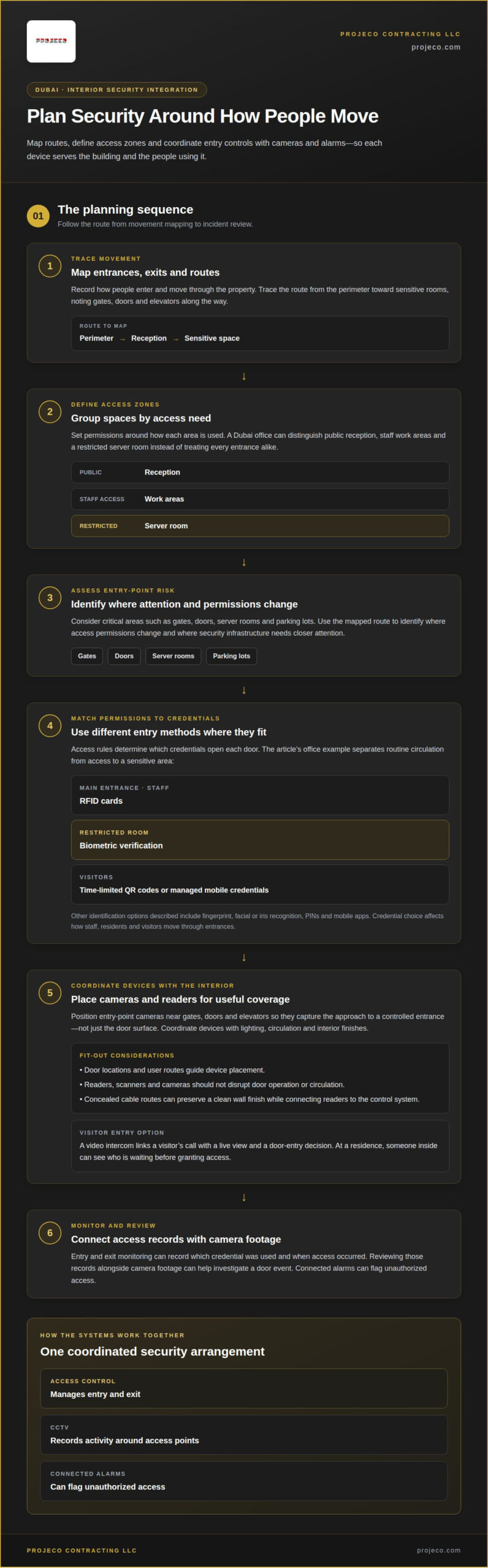
For instance, an office might use RFID cards for staff at its main entrance and biometric verification at a restricted room. Visitors could receive time-limited QR codes or use managed mobile credentials, while a PIN may be suitable in other situations. Access rules determine which credentials open each door. This separates routine circulation from access to sensitive areas without treating every entrance alike.
Integration also has an interior dimension. Readers, scanners and cameras need positions that serve their purpose without disrupting door operation, circulation or the look of a reception. During fit-out planning, door locations and user routes can guide device placement and cable coordination. Concealed cable routes, for example, can preserve a clean wall finish while connecting a reader to the wider control system.
Information security can influence these decisions for multinational companies. According to the International Organization for Standardization (ISO), ISO 27001 concerns information security and influences access-control decisions for multinational companies. This makes credential management and the handling of access records relevant to system planning, alongside the physical placement of readers. CCTV, access control systems and biometric recognition therefore need to be considered as connected parts of a building’s security arrangement.
Access zones, entry-point mapping, and risk assessment
High-end security and access control interior integration in Dubai starts with the building’s routes, entrances and sensitive spaces. Mapping them helps align monitoring technology with how people actually move through a property.
Zone and Entry-Point Planning
Zone planning groups spaces by access needs, while entry-point mapping records how people reach them. A risk assessment can identify critical areas such as gates, doors, server rooms and parking lots. For example, a Dubai office may distinguish its public reception from staff work areas and a restricted server room. This helps define where permissions change and where security infrastructure needs closer attention.
Entry and Exit Monitoring
Real-time entry and exit monitoring records movement through controlled doors and can produce security reports. In an office, those records can show which credential was used at an entrance and when access occurred. Monitoring is more useful when permissions match the building’s working patterns. Staff and visitor entrances, for example, can follow different rules while maintaining a clear movement record.
Entry-Point Cameras
Position entry-point cameras near access points such as gates, doors and elevators. They should capture the approach to a controlled entrance, not just the door surface. In an office lobby, a camera covering the entrance can provide context for an access event; an elevator camera can help show movement toward upper floors. Coordinating camera positions with doors, lighting and interior finishes supports useful coverage without obstructing circulation.
Video Intercom and Door Entry
A video intercom connects a visitor’s call at an entrance with a live view and a door-entry decision. At a residence, someone inside can see who is waiting before granting access. In a commercial building, the same arrangement can help reception distinguish an expected visitor from someone seeking entry without an appointment. A screen near the point where staff manage arrivals can support a clear process.
Risk assessment also considers what happens between the perimeter and a sensitive room. A mapped route might show a visitor passing through reception before reaching an office corridor. That route can guide where access permissions change, where cameras provide context and where an intercom is useful. This makes the security plan responsive to the building’s layout instead of relying on devices placed without regard to movement.
During interior planning, door swings, wall finishes, reception desks and cable routes all affect device placement. For high-end security and access control interior integration in Dubai, locating a reader beside the door handle can make entry more intuitive, while coordinating cabling before wall finishes are complete can reduce visible disruption. A coordinated interior security planning discussion can bring these spatial decisions into the fit-out process.
Access control integration with CCTV and alarms
Connected security systems link door permissions with surveillance and alarm events. In a corporate building, this coordination can help staff understand an alert in context.
CCTV and Alarm Integration
CCTV integration connects camera footage with access events, while alarms signal conditions that need attention. If someone uses an unauthorized credential at an office entrance, the system can trigger a response and associate the event with relevant video. Security personnel can then review what happened at the door instead of treating the access record and camera view as separate information.
Integration depends on clear event rules. A building’s security plan can define which door events trigger alerts, which cameras provide useful views and who receives notifications. For example, an attempted entry into a restricted office area may bring up a camera view of the relevant corridor. A routine employee entry can be recorded without triggering the same response.
Matching camera views to controlled doors is essential for useful review. If an access reader is beside a lobby door, the camera should show the approach and entry area. A camera aimed only at a nearby wall may record little that explains a door event. During interior coordination, plan device locations and sightlines alongside reception layouts and circulation routes.
Intrusion Alarm Integration
An integrated intrusion alarm connects a detected security event with predefined response procedures, surveillance, access control platforms and security personnel. For instance, an alarm associated with a restricted room can prompt staff to review nearby camera footage and relevant door activity. Defining the response in advance clarifies who handles the alert and what information supports the next decision.
Alarm events can involve different parts of a building, so response logic should reflect each space and its use. An alert near a service entrance may require a different review from one involving a secured office. Access permissions, camera coverage and assigned responders all shape how an event is assessed. Clear distinctions can reduce confusion when several alerts appear close together.
Software configuration is part of integration, not an afterthought. The control system needs event rules that connect the correct alarm input, door and camera. Testing an unauthorized-entry scenario can show whether the intended alert appears and whether staff can identify its location. Testing can also reveal mismatched camera views or access settings before the system is relied upon.
For Dubai buildings, the goal is a coordinated operational sequence: an event is detected, relevant door and video information is available, and designated security personnel follow the established response. Staff training supports consistent use of connected systems. Without clear roles, even an integrated alarm, camera and access platform can generate alerts that are difficult to interpret.
Integration with CCTV and other security systems
Access control can connect with CCTV, gates, elevators, smart-home technology and building management systems through coordinated permissions and event rules. An approved credential, for example, could authorize a gate and an elevator journey while keeping sensitive areas restricted.
Connected Security Systems
Connected security systems bring access permissions and monitoring into a coordinated operational arrangement. Modern platforms such as Digital-Vision.AI demonstrate how AI-powered video surveillance, alarms, and access control can be unified across residential and commercial properties. In a large or industrial facility, CCTV, access control and intrusion detection can feed a centralized Security Operations Centre. A central management system can also display CCTV and access activity on one dashboard, helping personnel review related events and respond with relevant information rather than managing disconnected applications.
Integration can extend beyond cameras and alarms. In a residence, access permissions can be coordinated with a gate or smart-home system; in a commercial building, they can work alongside elevator controls and building management systems. For example, an authorized credential could permit entry through a lobby gate and restrict elevator access to permitted floors. The building’s configuration determines how these connected actions are arranged.
Linking access logs with corresponding video footage can support incident analysis. If an unauthorized entry attempt occurs, personnel can review the access event alongside the relevant camera recording. In a corporate office, this connection can clarify whether a credential was rejected, which door was involved and what appeared on camera. Reports are more useful when event labels, door names and camera views correspond clearly.
Keypad Entry Systems
A keypad entry system uses a PIN entered at a door reader to request access. It can serve as a credential option for spaces such as a staff entrance or restricted service area. A keypad can also be used alongside another access method, with permissions reflecting different entry needs. Clear placement and legible signage make the process easier to understand.
Security planning should define which doors accept keypad credentials and how access is assigned. A PIN for a shared staff area, for example, serves a different purpose from a credential for a sensitive room. The control system can record door activity, while cameras provide visual context. Together, they help distinguish routine access from an attempt to enter an unauthorized area.
Connected systems also raise cybersecurity considerations. Strong firewalls and regular software updates help protect system data, while periodic testing can reveal gaps in camera angles or access settings. Test the full event path, from a credential decision to the dashboard or relevant recording. This checks whether integrated security solutions behave as intended across the building’s connected components.
Future-proofing starts with a scalable configuration that can accommodate additional doors, cameras or connected systems as a building changes. A growing office, for instance, may add a new restricted room without redesigning every existing access zone. Regular system testing and software updates support reliable operation as integrations evolve. For a coordinated fit-out discussion, contact the project team to consider how security infrastructure can align with the interior plan.
Access control for Dubai businesses and residences
Dubai homes and workplaces need access rules suited to their layout, users and operating needs. Residential privacy, visitor movement and business access each shape the appropriate system.
Discreet Devices for Luxury Properties
Discreet security devices integrate access readers, cameras and alarms with the interior’s layout and finishes. In a luxury villa or apartment, coordinated placement can preserve a composed entrance while keeping access points functional. Hotels also need clear visitor routes and controlled staff areas. Device selection should reflect each property’s circulation, privacy needs and facilities instead of applying the same arrangement everywhere.
SIRA Requirements for Buildings
SIRA guidelines establish minimum security standards for various facility types in Dubai. A security company managing access-control operations in Dubai must hold a valid SIRA company license. Requirements can depend on facility type and location, so SIRA, Dubai Civil Defence and building management should not be treated as one universal approval authority. The project context determines which requirements apply.
For residential premises, access control can distinguish residents from visitors and restrict entry to designated areas. In an office, staff permissions can separate public reception from sensitive rooms. Facial recognition, RFID cards and smartphone access are among the available methods. Choosing technology around actual movement can support efficient entry without giving every user the same permissions.
Systems and Brands in Luxury Projects
High-end systems for luxury interiors can combine biometric scanners, key-card access, smartphone applications, CCTV and alarms. Facial recognition is one possible biometric method, while RFID cards provide another credential option. The right combination depends on the property’s entry points, user groups and desired level of control. Integration and discreet placement matter as much as the individual devices.
Access-control brands commonly used in Dubai luxury projects can’t be named responsibly without substantiated manufacturer information. Focus instead on system capabilities: whether readers, credentials, cameras and alarms can work together, and whether permissions suit each area. For example, a villa might use controlled entry at its main door and separate permissions for staff spaces. A commercial facility may require distinct settings for visitors and employees.
For a fit-out, security decisions are most effective when considered alongside doors, finishes and circulation. A discussion about a coordinated residential interior with Projeco Contracting LLC | Villa Construction | Apartment Interiors Fit Out can connect those interior decisions with the property’s access requirements.
Applications include corporate offices, educational institutions, healthcare facilities, industrial sites and residential complexes. Systems regulate area entry, track staff movement and help prevent unauthorized entry; UAE cards use RFID at 125 kHz and 13.56 MHz.
Projeco Contracting LLC | Villa Construction | Apartment Interiors Fit Out
Projeco Contracting LLC | Villa Construction | Apartment Interiors Fit Out can incorporate security considerations into residential interior and renovation planning. When renovating a Dubai villa or apartment, door locations, circulation routes, wall finishes and device positions can be considered alongside access zones, helping the security plan fit naturally with the design.
Projeco’s Home Renovation, Residential Interior, Villa Renovation and Villa Fit Out services are relevant when security planning is part of a wider interior project. The focus is on coordinating the interior with the property’s functional needs, rather than treating security equipment as a standalone design feature.
For a residential renovation or fit-out where access requirements need to inform the interior plan, contact Projeco Contracting LLC | Villa Construction | Apartment Interiors Fit Out to discuss the project.
Shape the Next Stage of Your Interior Project
Security planning works best when considered alongside the space it serves. If you’re planning high-end security and access control interior integration in Dubai, use your next project discussion to connect entry requirements with the property’s layout, finishes and intended use. This creates a clearer brief for coordinating interior decisions with the relevant security professionals and building stakeholders.
Projeco Contracting LLC | Villa Construction | Apartment Interiors Fit Out offers Home Renovation, Residential Interior and Villa Renovation. These services can support residential projects where access considerations should inform renovation or interior planning, rather than being treated as a separate finishing detail.
Share your project goals and discuss how they can shape the interior planning process. Contact Projeco Contracting LLC | Villa Construction | Apartment Interiors Fit Out to take the next step with a considered vision for your property.
Frequently Asked Questions
What are the differences between biometric, mobile credential, card, and PIN access control in Dubai?
Biometric access verifies a personal characteristic, while mobile, card and PIN systems use a phone, credential card or code. For a Dubai office, a card may suit staff circulation, while a PIN can serve a shared service entrance. Biometrics may be considered for more restricted rooms. The practical choice depends on who needs access, how permissions are managed and how credentials are handled when roles change.
What is the installation process and typical timeline for security and access control integration in Dubai?
The process typically moves from assessing doors and access needs to coordinating equipment, cabling and interior finishes, then configuring and testing connected systems. A villa renovation, for example, may require coordination with door installation and wall finishing, while work in an occupied office may need to fit around daily operations. The schedule depends on the number of access points, system connections, site conditions and fit-out coordination required.
What are the best discreet security devices for luxury villas, apartments, and hotels in Dubai?
Biometric readers, card or mobile access devices, entry-point cameras and video intercoms can be integrated into the space. Coordinating device placement and concealing cable routes can help preserve interior finishes.