

In Dubai’s high-stakes real estate market, fit out works are far more than mere interior finishing; they represent a sophisticated engineering discipline that bridges the gap between a cold architectural shell and habitable luxury. While many view the process as a simple matter of aesthetics, the reality involves a complex orchestration of structural integrity, regulatory compliance, and meticulous craftsmanship. You might feel overwhelmed by technical jargon like Cat A versus Cat B or find yourself anxious about the stringent 2026 Dubai Municipality and Civil Defence approval processes. It’s a common concern that a beautiful design might falter during technical execution, leaving you with a space that looks the part but fails to perform.
We understand that achieving a world-class environment requires more than just a vision; it demands a precise roadmap and a partner who manages every technical detail. This guide provides that clarity, offering a comprehensive look at how to master the technical and aesthetic components of the process. You’ll gain a clear understanding of the value inherent in a turnkey design and build partner, alongside the knowledge required to achieve luxury standards in a functional space. From navigating the new 2026 contractor rating system to integrating sustainable biophilic elements, we’ll walk you through the essential steps to transform any bare shell into a masterpiece of sophistication.
Key Takeaways
- Distinguish between the structural “hardware” of a space and the aesthetic “software” to ensure your project remains functional and luxurious.
- Identify the specific requirements of Shell and Core, Category A, and Category B spaces to accurately define your project scope.
- Navigate the complex lifecycle of professional fit out works, including the critical phase of securing Dubai Municipality and Civil Defence approvals.
- Explore the technical components that define luxury, such as bespoke joinery and integrated MEP systems that provide invisible comfort.
- Evaluate the advantages of the Design & Build model in providing single-point accountability and preventing common budget overruns.
Understanding Fit Out Works: The Bridge from Shell to Habitation
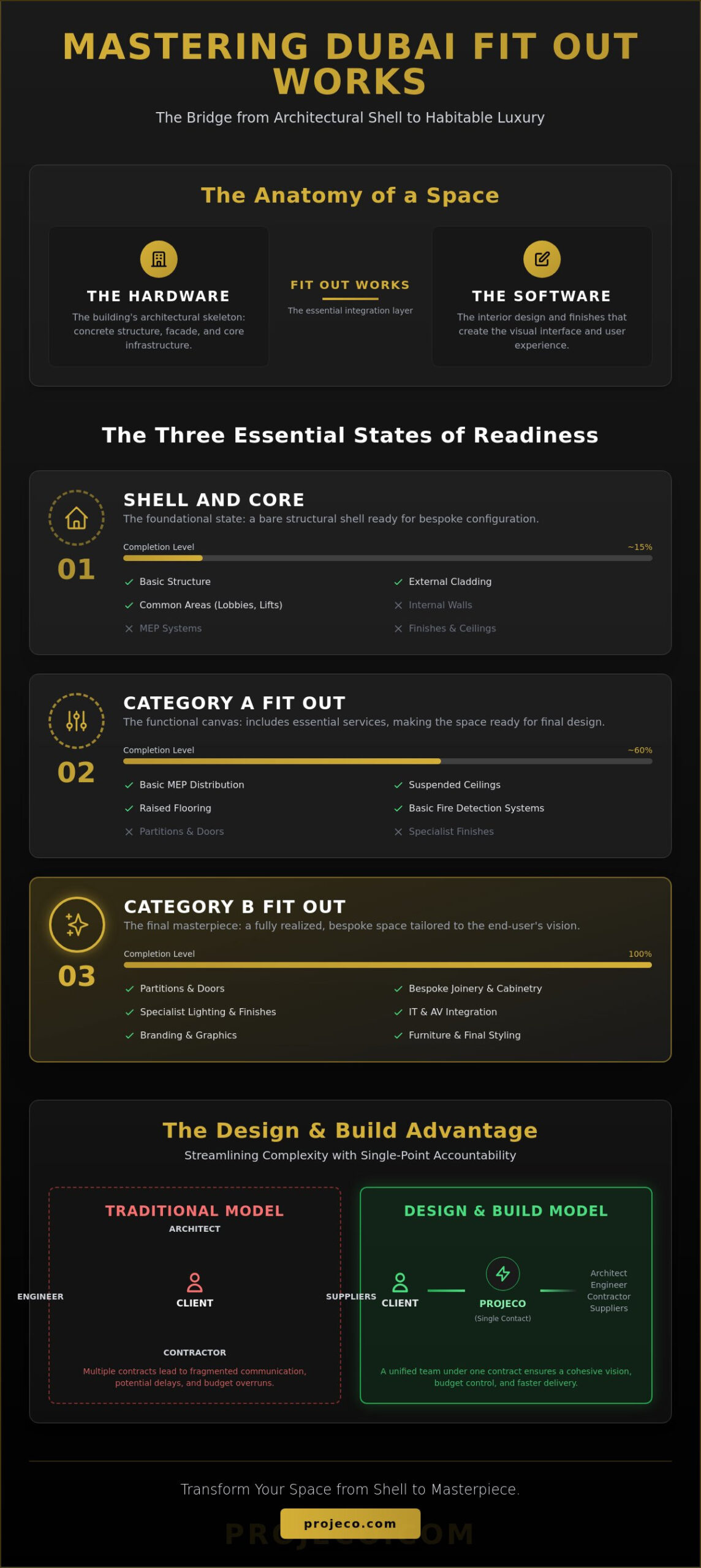
The term “fit out” often gets lost in a sea of design terminology, yet it represents the most critical phase of property development in Dubai. Fit out works are the technical and structural processes required to make an interior space habitable, safe, and operationally efficient. Think of the building’s architecture as the “hardware”, the concrete skeleton and glass facade, while the interior design acts as the “software” that provides the visual interface. The fit out is the essential integration layer that connects the two. It involves the installation of ceilings, partitions, floors, and complex mechanical, electrical, and plumbing (MEP) systems that define how a space feels and functions.
While the terms are sometimes used interchangeably, a distinction exists between these works and standard renovations. A renovation typically involves modifying or updating an existing habitable space. In contrast, fit out works usually begin with a “shell and core” unit where no previous interior infrastructure exists. Starting fresh requires a deep alignment with Open building concepts, where the base structure is designed to support various interior configurations over time. This approach ensures that the technical foundation is not just for the present, but remains adaptable for future requirements while maintaining strict building code compliance.
The Core Purpose of Fitting Out
Transforming a “cold shell” into a tailored environment is a feat of engineering and vision. It isn’t just about aesthetics; it’s about ensuring the space meets modern standards for acoustics, thermal comfort, and air quality. In Dubai’s climate, the efficiency of HVAC systems and the quality of insulation are non-negotiable for luxury living or high-performance commercial operations. Fit out works serve as the essential technical transition from architecture to interior experience. By adhering to the 2026 Dubai Municipality guidelines, these works ensure every square foot is compliant with safety codes and sustainable practices.
Fit Out vs. Interior Decoration
Interior decoration focuses on movable elements like furniture, art, and color palettes. Fit out works, however, involve permanent structural changes that define the very anatomy of the room. This includes everything from fire-rated partitions to custom-built joinery that is integrated into the walls. Base-build readiness must be achieved before any styling can commence. Projeco manages this complex transition through integrated design and build solutions, ensuring that the technical foundation perfectly supports the final aesthetic vision. You can view the results of this meticulous approach across our diverse portfolio of luxury projects.
The transition from a bare concrete unit to a functional, luxury environment is a methodical journey. It requires an authoritative understanding of both engineering and artistry. Professional fit out works provide the structural integrity needed to support high-end finishes, ensuring that the “bones” of the interior are as robust as they are beautiful. This process is fundamental to achieving operational efficiency, particularly in commercial or F&B settings where kitchen layouts and ventilation are paramount for success.
The Three Essential Categories: Shell and Core, Category A, and Category B
In Dubai’s high-velocity real estate market, properties are delivered in various states of readiness. Identifying where your property sits on this spectrum is the first step toward a successful transformation. The industry classifies these stages into three distinct categories: Shell and Core, Category A, and Category B. Each tier represents a different level of completion and requires a specific strategic approach to fit out works. Selecting the right starting point depends entirely on your investment goals, whether you’re developing a flagship corporate headquarters or a bespoke luxury villa.
Shell and Core: The Foundation
Shell and Core is the most basic state of a building’s interior. In a standard Dubai delivery, you can expect the basic concrete structure, external cladding, and completed common areas like lobbies and lift shafts. While the unit will have “capped off” connections for water and electricity, it lacks internal walls, flooring, and ceilings. For owners of luxury villas or specialized F&B outlets, this bare-bones state offers the ultimate advantage: total creative freedom. You aren’t constrained by existing layouts or basic finishes. However, starting from a shell requires meticulous planning for structural modifications and early engagement with authorities for necessary permits. It’s the most intensive path, yet it yields the most personalized results.
Cat A vs. Cat B: The Occupancy Gap
Category A (Cat A) is frequently found in premium commercial developments across the UAE. It provides a “blank canvas” that includes basic mechanical and electrical services, finished floors, and suspended ceilings. While functional, a Cat A space lacks the soul and specific utility required for a modern business. This is where Category B (Cat B) becomes essential. A Cat B fit out is the final, bespoke layer that tailors the space to the occupant’s specific branding and functional needs. This phase involves the installation of partitions, high-end joinery, specialized lighting, and integrated IT infrastructure. According to JLL’s Fit-Out Costs Guide, the transition from Cat A to Cat B is where the most significant value is added to a property’s operational capacity.
Most premium office environments in Dubai begin with a Cat A baseline provided by the landlord, allowing the tenant to focus their investment on the Cat B elements that reflect their corporate identity. Projeco excels in managing these transitions, executing sophisticated commercial fit out projects that bridge the gap between a generic space and a high-performance environment. Whether you’re starting from a concrete shell or a basic office floor, we ensure the technical execution matches the aesthetic ambition. If you’re ready to define the scope of your next project, our team is available to discuss your specific requirements.
Understanding these categories helps you avoid the common pitfall of underestimating the “hardware” required before the “software” of interior design can be installed. By aligning your property’s current state with your ultimate vision, you create a roadmap that respects both your timeline and your budget. This clarity is what separates a standard construction project from a truly sophisticated interior transformation.
The Lifecycle of Professional Fit Out Works: A Strategic Roadmap
The transition from an architectural shell to a sophisticated, habitable environment follows a rigorous, five-phase lifecycle. This methodical progression ensures that the initial creative vision remains anchored in technical reality. Executing premium fit out works in Dubai requires more than just artistic flair; it demands a disciplined orchestration of engineering, legal compliance, and craftsmanship. Each phase serves as a critical checkpoint, preventing the common disconnect between a beautiful concept and a technically flawed reality.
- Phase 1: Pre-construction and Feasibility. This initial stage involves aligning the design vision with the structural and budgetary constraints of the site. It’s where we identify potential technical hurdles before they become costly delays.
- Phase 2: Detailed Engineering and Authority Approvals. Here, conceptual sketches are transformed into precise technical drawings. This phase is dedicated to securing mandatory permits from the Dubai Municipality, Civil Defence, and DEWA.
- Phase 3: Civil Works and Structural Modifications. This is the heavy lifting of the process. It includes the installation of partitions, flooring, and any structural adjustments required to redefine the space’s anatomy.
- Phase 4: MEP Installation and High-End Finishing. Precision meets luxury in this stage. We integrate advanced mechanical, electrical, and plumbing systems alongside the application of bespoke finishes and joinery.
- Phase 5: Testing, Commissioning, and Handover. Before occupancy, every system undergoes rigorous testing. We ensure that climate control, lighting, and safety features operate at peak performance, followed by a final walkthrough and formal handover.
Navigating Dubai Authority Approvals
Securing the necessary permissions is often the most complex aspect of any project in the UAE. As of the 2026 Dubai Municipality guidelines, a fit-out permit is mandatory before any physical work commences. The contractor plays an essential role in securing No Objection Certificates (NOCs) and ensuring all plans meet the Green Building Declaration requirements. Specialized F&B fit out projects require even greater scrutiny, necessitating additional health and safety certifications to ensure the space is fit for commercial food operations. Managing these timeline expectations requires an authoritative understanding of government inspection schedules and regulatory nuances.
Execution and Project Management
Maintaining high-register quality standards depends on unwavering site supervision. Meticulous project management prevents timeline bottlenecks by ensuring seamless coordination between different trades, from electricians to master joiners. Every detail must be scrutinized to ensure the final result matches the promised sophistication. You can explore Projeco’s portfolio for examples of this meticulous execution in high-end environments, where technical discipline and luxury design converge. It’s this commitment to the complete solution that ensures a space isn’t just finished, but perfected for its intended purpose.
Key Technical Elements of Luxury Fit Out Works
Luxury is often perceived as a visual result, but it’s fundamentally a technical achievement. In the context of premium fit out works, true sophistication is found in the seamless integration of structural engineering and artisanal craft. While commercial offices often prioritize operational efficiency, luxury residential projects in Dubai demand a deeper focus on personalized, permanent features that withstand the test of time and climate. Achieving this level of quality requires a meticulous eye for the “invisible” components that support the final aesthetic layer.
Artisanal Joinery and Custom Carpentry
Bespoke joinery is the definitive hallmark of a high-end interior. Custom-built wardrobes, intricate kitchen cabinetry, and hand-finished wall paneling don’t just fill a room; they define its anatomy. In Dubai’s unique environment, where humidity and temperature fluctuations are constant, the technical requirement for joinery to remain stable is paramount. We select only the finest seasoned timbers and advanced bonding agents to prevent warping or cracking over time. Projeco utilizes high-end joinery to elevate villa interior design, ensuring that every built-in element is a unique reflection of the owner’s lifestyle and a testament to refined craftsmanship.
MEP: The Backbone of Functionality
Mechanical, Electrical, and Plumbing (MEP) systems act as the “invisible luxury” of a modern space. A truly sophisticated environment isn’t just beautiful; it’s effortless. This involves integrating smart home automation and high-efficiency HVAC systems that provide silent, consistent climate control. Lighting design is treated as a technical fit out element rather than a decorative choice, with layouts engineered to support long-term operational ease. We ensure that every sensor, outlet, and control panel is placed with surgical precision, allowing the technology to enhance the living experience without cluttering the visual field. This technical backbone is what ensures the space remains functional under the high demands of Dubai’s urban lifestyle.
Beyond these core systems, the selection of surface finishes requires a curator’s eye and a technician’s hand. From rare marble flooring to custom wall treatments, the application must be flawless to maintain a luxury standard. Structural integrity remains the priority, especially when managing extensions or internal mezzanine levels. These modifications must be executed safely, adhering to the 2026 Dubai Municipality standards for load-bearing and fire safety. If you’re seeking a partner to manage these intricate technical layers with unwavering precision, contact our specialist team today to discuss your vision.
Managing these elements requires a “complete solution” mindset. By coordinating artisanal joinery with advanced MEP and structural modifications, we eliminate the friction between design and execution. This holistic approach ensures that your space isn’t just a collection of expensive materials, but a cohesive, high-performance environment that delivers on the promise of luxury.
Selecting an Interior Fit Out Partner: The Design & Build Advantage
The final and most consequential step in your journey from a bare shell to a sophisticated environment is the selection of a delivery partner. In Dubai’s fast-moving market, the traditional “Design-Bid-Build” model frequently introduces friction that leads to budget overruns and timeline delays. This fragmented approach separates the visionary designer from the technical contractor, often creating a disconnect where the aesthetic ambition isn’t grounded in structural reality. Choosing an integrated partner for your fit out works mitigates these risks by providing a single point of accountability for both the creative vision and the technical execution.
A professional partner must be vetted beyond the visual appeal of their portfolio. In 2026, the Dubai Municipality’s updated contractor rating system places a premium on technical capacity, safety compliance, and sustainability practices. You should look for a firm that possesses comprehensive insurance and the necessary technical certifications to handle complex MEP and structural modifications. To ensure you apply the right benchmarks when evaluating firms, our ultimate vetting checklist for luxury fit out companies in Dubai provides a professional 2026 framework covering technical capacity, regulatory compliance, and meticulous quality standards. Projeco delivers turnkey solutions that prioritize this blend of aesthetic luxury and functional rigor, ensuring that every project is as robust as it is beautiful.
Eliminating the Disconnect
Integrated teams prevent the common pitfall of designs that are either impossible to build or prohibitively expensive. When designers and engineers work in the same room, they engage in value engineering from the very first sketch. This process protects your budget by identifying cost-effective materials and construction methods without compromising the high-register quality of the final result. Furthermore, a single expert entity streamlines the approval process with the Dubai Municipality and Civil Defence, as they possess a holistic understanding of the project’s technical requirements and regulatory obligations.
The Final Handover: Beyond the Punch List
A professional handover is more than a simple exchange of keys; it’s a comprehensive transfer of the building’s technical and intellectual property. This stage includes the delivery of as-built drawings, detailed operation manuals for smart systems, and structural warranties. For luxury residential and commercial spaces, post-occupancy support is vital to ensure that every system continues to operate at peak performance. It’s this commitment to the complete lifecycle of the space that defines a premium service. If you’re ready to transform your property with a partner who manages every detail with precision, we encourage you to contact Projeco for a consultation on your upcoming fit out works.
By choosing the Design & Build model, you aren’t just hiring a contractor; you’re engaging a visionary craftsman who understands the delicate balance between form and function. This integrated approach ensures that the “hardware” of your building’s shell and the “software” of its interior design work in perfect harmony, delivering a space that is truly sophisticated in every sense.
Elevating Your Vision Through Technical Excellence
Transforming a bare shell into a sophisticated environment requires more than just an eye for design; it demands a disciplined understanding of the structural hardware and a strategic roadmap through the project’s lifecycle. By mastering the distinction between Shell and Core, Cat A, and Cat B categories, you ensure your investment is built on a foundation of functional rigor and aesthetic luxury. Success in the Dubai market doesn’t come from luck; it hinges on choosing a partner who provides a complete, integrated solution.
Projeco offers a specialized Design & Build approach that ensures seamless execution for premium F&B and luxury villa projects. We provide full management of all essential Dubai authority approvals, including Municipality and Civil Defence permits, to ensure your fit out works remain compliant and on schedule. Our commitment to high-register craftsmanship and visionary design eliminates the disconnect between concept and reality. Explore Projeco’s Award-Winning Fit Out Portfolio and discover how we can refine your next space with unwavering reliability. Your journey toward a functional, luxury environment starts when you refuse to settle for anything less than perfection.
Frequently Asked Questions
How long does a typical fit out project take in Dubai?
A standard project typically spans between 10 to 16 weeks from the initial design phase to the final handover. The duration depends heavily on the scale of the unit and the complexity of the technical requirements. Authority approvals from the Dubai Municipality and Civil Defence usually require three to four weeks, while the physical execution follows a methodical timeline to ensure precision and quality.
What is the difference between fit out works and interior design?
Fit out works represent the structural and technical hardware required to make a space habitable, whereas interior design is the aesthetic software that provides the visual finish. While a designer focuses on color palettes and furniture selection, a fit out contractor manages the installation of MEP systems, partitions, and ceilings. This technical foundation is what allows the design vision to function effectively in a real-world environment.
Do I need Dubai Municipality approval for my villa fit out?
You absolutely require a permit from the Dubai Municipality for any villa modification that involves structural changes or utility upgrades. The 2026 guidelines mandate that all projects must secure an official No Objection Certificate from the developer before work begins. This ensures the property remains compliant with safety, sustainability, and community standards throughout the transformation process.
What are the main costs involved in fit out works?
The primary financial components include government permit fees, technical engineering for MEP systems, and the procurement of premium materials. Specialized joinery and artisanal finishes also represent a significant portion of the investment. It’s widely recommended to maintain a contingency budget of 10-15% to account for unforeseen technical adjustments during the construction phase without compromising the final result.
Can I stay in my property while fit out works are being carried out?
Staying in the property is rarely feasible for comprehensive projects due to significant utility interruptions and safety protocols. The process involves high levels of dust, noise, and the presence of various specialized trades working in a coordinated rhythm. Vacating the space allows the team to maintain a more efficient timeline and ensures the highest standards of safety and cleanliness are maintained throughout the site.
What is included in a “Shell and Core” space?
A Shell and Core space consists of the basic concrete structure, external glazing, and completed common areas like lobbies and elevators. The interior of the unit is delivered as a bare concrete shell with capped-off utility connections for water and electricity. This state offers the ultimate flexibility for owners who wish to create a completely bespoke environment from the ground up without being limited by existing finishes.
How do I choose between a boutique fit out company and a large contractor?
Your choice should align with the specific complexity and desired finish of your project. Large contractors are often suited for repetitive, high-volume industrial tasks, while boutique firms provide the meticulous attention to detail required for luxury villas and F&B outlets. A boutique partner often excels in the integrated Design & Build model, offering a single point of accountability and a more personalized service level. Before making your final decision, reviewing a structured vetting checklist for luxury fit out companies in Dubai can help you apply consistent, professional criteria to every firm you evaluate.
What insurance should a fit out contractor have in the UAE?
In the UAE, a reputable contractor must hold valid Third-Party Liability and Workmen’s Compensation insurance to protect the project and the staff. If you’re engaging a firm for an integrated solution, they should also possess Professional Indemnity insurance. This coverage is essential to mitigate risks associated with design errors or technical failures during the execution phase, providing peace of mind for the property owner.