

What if the most critical element of your luxury villa’s design isn’t the Italian marble or the bespoke joinery, but the digital stamp on your drawing set? You likely recognize that in the high-stakes world of Dubai real estate, a single administrative oversight can stall a multi-million dirham project for months. The distinction between Mainland and Free Zone requirements often feels like a moving target, especially with the full implementation of Law No. 7 of 2025. Securing approvals dubai requires more than just technical drawings; it demands a strategic understanding of a unified, digital regulatory landscape that values precision and safety above all else.
This guide provides a definitive roadmap to mastering the approval process for 2026. It ensures your high-end residential or commercial project moves from concept to completion without the burden of rejected drawings or unexpected fines. We’ll explore the specific mandates of the Dubai Municipality and Civil Defence, outline the current timeline for luxury fit-outs, and explain how a seasoned turnkey partner manages these complexities with meticulous care. By the end of this article, you’ll have the clarity needed to execute your vision with absolute confidence and professional poise.
Key Takeaways
- Discover how 2026 standards prioritize sustainability and smart building integration, ensuring your luxury project aligns with the latest environmental mandates.
- Identify the essential roles of the Dubai Municipality and Civil Defence to navigate the complex landscape of approvals dubai with absolute precision.
- Understand the critical differences between Mainland and Free Zone jurisdictions to determine the specific regulatory roadmap and fee structure for your property.
- Master the submission lifecycle, from securing initial No Objection Certificates to finalizing detailed engineering drawings for structural and MEP compliance.
- Learn how an integrated turnkey partner eliminates the “Design-Approval Gap” by pre-vetting bespoke concepts against rigorous authority standards.
Understanding the Landscape of Approvals in Dubai (2026)
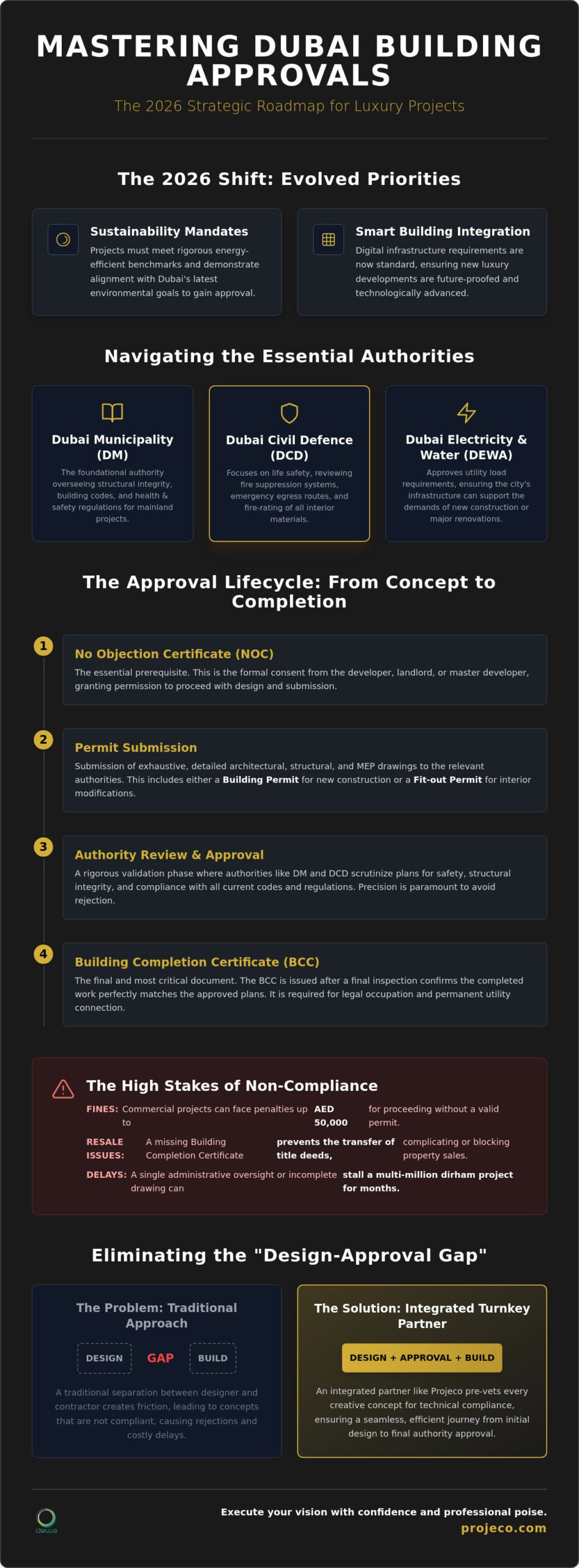
In the context of premium real estate, “approvals dubai” refers to the mandatory legal consent required from the Government of Dubai and its associated semi-government entities before any physical construction or fit-out begins. These are not merely administrative checkboxes. They represent a rigorous validation of safety, structural integrity, and aesthetic alignment with the city’s urban vision. By 2026, these standards have evolved to prioritize sustainability and smart building integration. Every high-end residential or commercial project must now demonstrate compliance with energy-efficient benchmarks and digital infrastructure requirements to secure the necessary permits.
Success in the approval phase is directly proportional to the precision of your architectural design. Incomplete or vague drawings are the primary cause of project delays. For luxury developments, where bespoke elements are the norm, the complexity increases. Authorities expect exhaustive detail. Proceeding without the correct approvals dubai can lead to severe consequences. Commercial projects without a valid permit can face fines up to AED 50,000, while residential violations often complicate property resale, as a missing Building Completion Certificate prevents the transfer of title deeds.
The Role of the Consultant vs. the Contractor
Legal responsibility for technical submissions rests with the consultant of record. They must ensure every drawing bears the signature of a registered engineer who assumes liability for structural stability. However, a traditional separation between the designer and the builder often creates a “Design-Approval Gap.” Projeco’s integrated design and build approach eliminates this friction. By housing both disciplines under one roof, we ensure that every creative concept is pre-vetted for technical compliance. You can explore our portfolio of successfully approved luxury projects to see the results of this unified strategy.
Key Terminology: NOCs, Permits, and Completion Certificates
Navigating the process requires an understanding of three core documents. The No Objection Certificate (NOC) is your prerequisite. It’s the developer’s or landlord’s formal consent to proceed. Next is the Permit. A Building Permit covers new construction or structural changes, while a Fit-out Permit is specific to interior modifications. Finally, the Building Completion Certificate (BCC) is the most critical document for handover. It confirms that the finished work matches the approved plans. Without it, you cannot legally occupy the space or connect permanent utilities.
The Essential Authorities: Who Governs Your Luxury Project?
The governance of a high-end project in Dubai is characterized by a precise hierarchy of government and semi-government entities. Each authority maintains distinct standards to ensure that the city’s rapid growth aligns with global safety and aesthetic benchmarks. For any investor or homeowner, understanding the jurisdiction of these bodies is the first step toward securing approvals dubai without the friction of repeated rejections. The landscape is divided between broad municipal oversight and specialized safety and utility requirements, all of which must be synchronized perfectly for a successful handover.
The Dubai Municipality (DM) serves as the foundational authority for mainland projects, overseeing everything from structural integrity to health and safety regulations. While DM manages the broader construction framework, the Dubai Civil Defense (DCD) focuses on the life safety aspects of the design. This includes a rigorous review of fire suppression systems, emergency egress routes, and the fire-rating of interior materials. Complementing these is the Dubai Electricity and Water Authority (DEWA), which must approve the utility load requirements for any significant renovation or new build to ensure the existing infrastructure can support your project’s demands.
Mainland Authorities (DM and DCD)
The 2026 update to the “Dubai Building Code” has introduced stricter requirements for structural and architectural submissions, demanding higher levels of detail in digital models. DCD reviews interior materials and MEP layouts with a focus on fire retardancy and smoke management systems, ensuring that bespoke finishes do not compromise safety. In 2026, all applications are processed exclusively through the unified Dubai Building Permit System portal to streamline the digital verification of technical drawings.
Master Developer NOCs (Nakheel, Emaar, Sobha)
Luxury projects often reside within private communities where master developers hold significant regulatory power. For luxury villa construction in gated enclaves like the Palm Jumeirah, obtaining an NOC from the developer is mandatory. These entities enforce strict aesthetic guidelines, regulating exterior finishes and landscape modifications to preserve community identity. Settling community-specific service charges early is vital to prevent delays in the approval timeline.
Managing these multi-layered requirements demands a partner who understands the nuances of each jurisdiction. If you are preparing for a new development, you can consult with our technical team to ensure your project meets every regulatory milestone with absolute precision.
Strategic Differences: Mainland vs. Free Zone Approval Processes
The geographical location of your property is the single most influential factor in your project’s regulatory roadmap. While Law No. 7 of 2025 has introduced a unified digital system to streamline contracting activities across the emirate, the specific authority governing your plot still dictates the technical standards and fee structures you must follow. Mainland projects fall under the standard Dubai Municipality jurisdiction, where building permit fees are currently set at AED 1.00 per square foot of Built-Up Area. Conversely, Free Zones operate under autonomous frameworks that often require specialized third-party inspections to validate structural and MEP compliance before a final handover is permitted.
Projeco manages these cross-jurisdictional complexities through a unified compliance team that stays abreast of the shifting requirements in both Mainland and specialized zones. This ensures that whether your project is a luxury villa or a high-end corporate office, the approvals dubai process remains seamless and predictable. Our integrated model allows us to anticipate authority-specific nuances, preventing the common delays associated with misinterpreting drawing standards between different jurisdictions.
Trakhees and the Dubai Development Authority (DDA)
Trakhees oversees approvals for JAFZA, Nakheel communities, and Dubai World properties, maintaining rigorous environmental and health standards. The Dubai Development Authority (DDA) governs creative and technology hubs like Dubai Media City and the Design District. A key distinction lies in the drawing standards; while the Municipality focuses on traditional urban planning, DDA and Trakhees often require more granular data regarding sustainable material sourcing and sophisticated waste management protocols during the construction phase.
Special Economic Zones: DIFC and DSO
The Dubai International Financial Centre (DIFC) maintains some of the most stringent requirements for commercial fit out dubai, focusing on acoustic performance and high-tier fire safety within its vertical infrastructure. Meanwhile, Dubai Silicon Oasis (DSO) integrates technology-driven building standards that favor smart-home automation and energy-efficient systems. Both zones offer expedited “fast-track” approval options for projects that meet specific pre-qualification criteria, allowing for a condensed timeline compared to standard mainland submissions.
Step-by-Step: The Lifecycle of a Successful Approval Submission
A successful luxury project is a linear progression through specific government milestones. Each phase requires a different level of technical rigor and administrative finesse. To secure approvals dubai without unnecessary delays, you must follow a structured lifecycle that begins long before the first stone is laid. This process ensures that your creative vision is technically viable and legally compliant from the outset. It’s a methodical journey that transforms a conceptual design into a physical reality while adhering to the highest safety standards.
- Phase 1: Concept Design and Preliminary NOC. This initial stage involves securing formal consent from the landlord or master developer to ensure the design respects community guidelines.
- Phase 2: Detailed Engineering Drawings. Consultants develop comprehensive MEP, structural, and fire safety layouts that meet the specific codes of the governing authority.
- Phase 3: Authority Submission. Technical dossiers are uploaded to digital portals such as the Dubai Building Permit System or Trakhees for official review.
- Phase 4: Site Inspections. During construction, authorities conduct periodic checks to verify that the physical work mirrors the approved digital models.
- Phase 5: Final Completion Certificate. Once the project passes final inspection, the Building Completion Certificate is issued, enabling utility activation and legal occupancy.
The Importance of Accurate MEP and Structural Drawings
Precision in engineering is the bedrock of a successful submission. For example, luxury interior lighting plans must be perfectly synchronized with DEWA load schedules to avoid power capacity issues. Many projects face rejection because of minor discrepancies between structural drawings and the proposed interior modifications. As of 2026, all technical submissions must be presented as digital BIM (Building Information Modeling) files to facilitate automated compliance verification by the authorities.
Managing Timelines and Expedited Approvals
The duration of the approval cycle depends largely on the project type. A high-end apartment fit out typically moves through the system faster than a ground-up villa construction, which involves more complex structural reviews. When deadlines are tight, we utilize “Express” services offered by entities like the Dubai Municipality to move critical path projects to the front of the queue. Projeco’s dedicated Public Relations Officer manages these liaisons daily, ensuring that administrative bottlenecks don’t compromise your move-in date.
If you are ready to begin your project without the stress of regulatory hurdles, contact our specialists today to discuss your submission strategy.
Why a Turnkey Design & Build Partner is Your Best Approval Strategy
Engaging separate consultants and contractors often creates a “Design-Approval Gap” that can derail even the most inspired project. In this fragmented model, an architect may prioritize aesthetics without fully accounting for the technical constraints of the Dubai Building Code. This misalignment results in repeated drawing rejections, mounting administrative fees, and significant delays. Choosing an integrated partner ensures that every approvals dubai requirement is hard-coded into the design phase. This synergy between the visionary and the engineer guarantees that a concept is not only beautiful but also fully executable within the city’s regulatory framework.
Projeco’s integrated model ensures that every luxury interior concept is pre-vetted for technical compliance before it ever reaches an authority portal. We mitigate financial risk by offering fixed-fee approval management, shielding you from the hidden costs of resubmission or technical amendments. Consider a recent case study involving a premium Palm Jumeirah villa where a proposed structural expansion faced a critical bottleneck with Trakhees. By leveraging our in-house engineering team, we revised the load-bearing calculations and secured the necessary permits within seven working days, preventing a projected three-month delay.
Single Point of Accountability
A turnkey approach eliminates the common “blame game” between architects and contractors during site inspections. When one entity is responsible for the entire documentation trail, from the initial NOC to the final BCC, the process becomes transparent and efficient. Projeco manages every interaction with government bodies, ensuring a consistent flow of information and a higher first-time approval rate. You can review our extensive portfolio of successfully approved projects to see how this meticulous management translates into flawless execution.
Ensuring Long-Term Property Value
Professional approval management provides peace of mind that extends far beyond the handover date. 100% legal compliance and the provision of accurate “As-Built” documentation are essential for maintaining the long-term value of your asset. These records facilitate future renovations and ensure a smooth transaction during property sales, as buyers in 2026 are increasingly diligent about verifying the permit history of high-end homes. To understand how compliance intersects with aesthetics, our comprehensive guide to villa interior design in Dubai outlines the specific material and technical standards that define a fully compliant luxury residence. To secure the integrity of your investment and ensure a seamless approvals dubai journey, consult with Projeco to begin your project with absolute certainty.
Mastering the Regulatory Horizon for Your 2026 Vision
Securing approvals dubai requires more than technical proficiency; it demands a strategic alignment with the city’s evolving digital and environmental mandates. Success in this landscape depends on recognizing the distinct requirements of each jurisdiction and ensuring that every design element is pre-vetted for compliance. By bridging the gap between ambitious architectural concepts and strict authority standards, you protect both your timeline and your investment. A methodical approach to documentation and liaison is the only way to ensure a seamless transition from drawing board to physical reality.
As a Dubai Municipality and Trakhees Approved Contractor, Projeco provides the unwavering reliability required for high-end villa and commercial projects. Our in-house PRO and engineering team manage the entire lifecycle of your project, ensuring that every bespoke detail meets the rigorous expectations of Dubai’s governing bodies. We take pride in navigating these complexities so you don’t have to. Your vision deserves an execution that is as polished and professional as the design itself.
Secure Your Project’s Future with Projeco’s Expert Approval Management
Let’s build your legacy with the confidence that every regulatory milestone is handled with absolute precision and professional poise.
Frequently Asked Questions
How long does it typically take to get fit-out approvals in Dubai?
Standard fit-out approvals dubai typically take between 10 to 15 working days for most interior projects. Major villa construction or significant structural modifications can extend this timeline to 30 or 45 days. These durations depend heavily on the accuracy of the initial submission and the specific response times of authorities like Trakhees or the Dubai Municipality.
Do I need a new approval for minor interior renovations in a Dubai apartment?
Most interior renovations require a formal permit if they involve structural changes, MEP modifications, or any alterations to the building’s fire safety systems. Even minor aesthetic work often necessitates a No Objection Certificate from your building management or developer. Failing to secure these documents can lead to complications during final inspections or future property transactions.
What is the difference between a Building Permit and an NOC?
A No Objection Certificate is the developer’s formal consent to your project, whereas a Building Permit is the legal authorization from the government. You must secure the NOC first as it’s a prerequisite for the permit application. The permit validates that your technical drawings comply with the Dubai Building Code and safety regulations.
Can I start my project while the Dubai Municipality approval is still pending?
Commencing construction work while a Dubai Municipality approval is pending is strictly prohibited and carries significant legal risks. Authorities conduct regular site inspections to ensure that no physical activity begins without a valid digital permit. Early commencement results in immediate stop-work orders and substantial financial penalties that can derail your project’s budget.
How much are the typical government fees for construction approvals in 2026?
In 2026, the Dubai Municipality building permit fee is set at AED 1.00 per square foot of Built-Up Area. Dubai Civil Defence drawing approval fees for specialized contractors are typically AED 1,010 per plot. These figures represent the standard government costs and don’t include the administrative fees associated with master developer NOCs or third-party inspections.
What happens if I perform construction work without a permit in Dubai?
Performing construction work without a valid permit can lead to fines of up to AED 50,000 for commercial projects. Beyond financial penalties, you may face a mandatory demolition order for any unauthorized structures. Such violations also prevent the issuance of a Building Completion Certificate, making it impossible to legally occupy or sell the property.
Is a DEWA approval required for every interior fit-out project?
DEWA approval is mandatory for any fit-out that alters the existing electrical load or water connection points. This ensures that the building’s infrastructure can safely accommodate your project’s technical requirements. Even high-end approvals dubai for residential interiors must be synchronized with DEWA load schedules to prevent utility disruptions or long-term safety hazards.
Why do I need an NOC from my Master Developer (like Emaar or Nakheel)?
Master developers require an NOC to ensure your project aligns with the community’s aesthetic and structural standards. This process protects the visual harmony and property values of the entire development. It also confirms that you’ve settled all outstanding service charges before beginning any modification work on your specific plot or unit.