

Dubai’s heat, humidity and blowing sand make material choice a performance decision, not just an aesthetic one. Five materials that can withstand Dubai’s climate include fiber cement, reflective glass, natural stone, treated wood and enhanced concrete. Each suits different parts of a building, and its performance depends on matching it to the exposure and installing it with the right protection and detailing.
Heat is only one factor. Humidity, UV exposure, dust and thermal movement also affect how building materials age. This guide explains how these conditions challenge surfaces and finishes, what to consider when choosing each of the five materials, and how fiber cement performs in humid, sandy settings. It also covers selection and installation mistakes that can undermine durability, helping you make informed decisions for a Dubai home or renovation.
Key Takeaways
- Choose materials for the combined effects of heat, UV exposure, humidity, dust and sand, not appearance alone.
- Match each material to its use: reflective glass, stone, treated wood, enhanced concrete and fiber cement each suit different conditions and applications.
- Consider fiber cement for humid, sandy environments, and assess how moisture protection and surface treatment affect its performance.
- Allow for thermal movement in material selection and installation to help reduce stress at joints and connections.
- Avoid common installation mistakes by using suitable exterior products and applying them to properly prepared surfaces.
1. What building materials are used in Dubai?
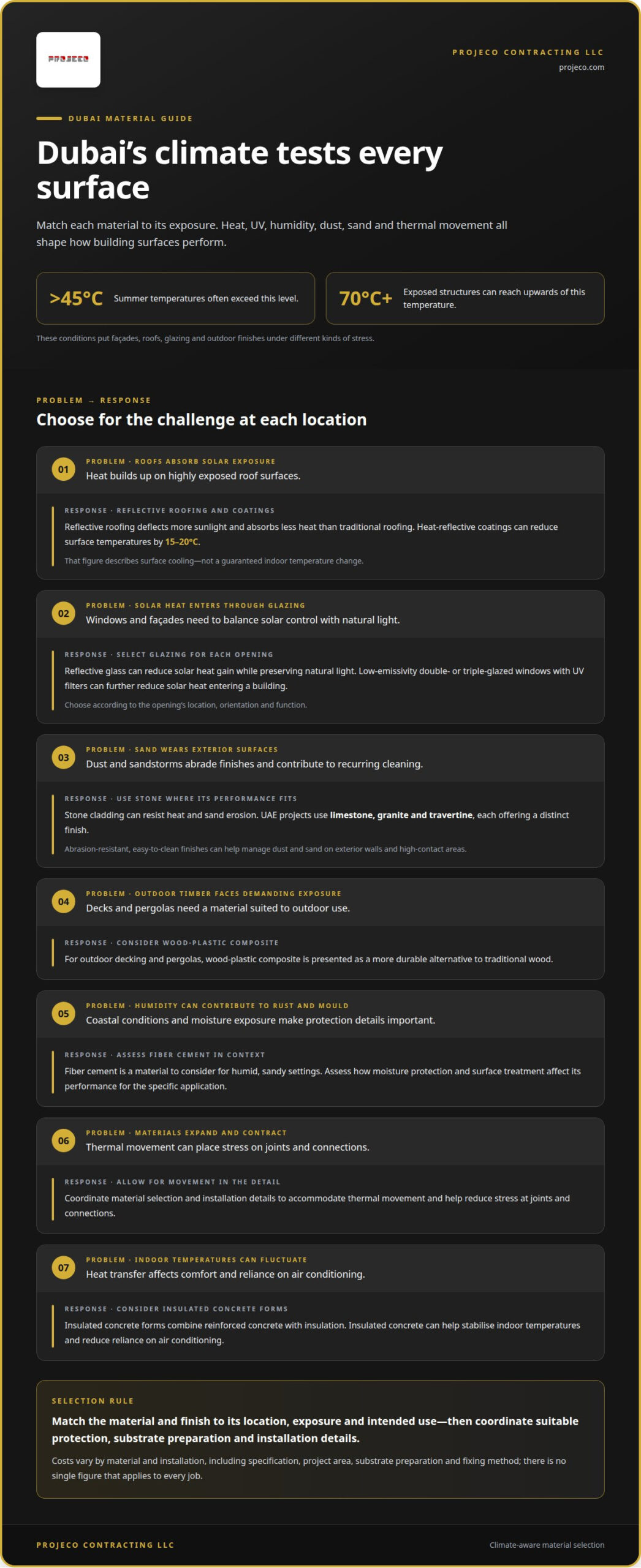
Dubai’s heat challenges façades, roofs, glazing and outdoor finishes differently. Summer temperatures often exceed 45°C, while exposed structures can reach upwards of 70°C. Dense urban surfaces absorb and release heat, contributing to the urban heat island effect. Materials that withstand Dubai’s climate must therefore manage solar exposure, thermal movement and everyday wear, not simply look appropriate at installation.
Roofs are highly exposed to the elements. Reflective roofing materials deflect more sunlight and absorb less heat than traditional roofing, helping limit heat buildup at the roof surface. Reflective glass can also reduce solar heat gain while preserving natural light, making it suitable for windows and façades. Low-emissivity double- or triple-glazed windows with UV filters can further reduce solar heat entering a building. Choose glazing according to each opening’s location, orientation and function.
Dubai’s conditions extend beyond direct sun. Humidity, especially near the coast, can contribute to rust and mould, while dust and sandstorms wear exterior surfaces and allow dust to enter buildings. Select materials according to their exposure. Façade stone, for example, is used on UAE luxury villas and commercial projects. Limestone, granite and travertine offer distinct finishes, while stone cladding can resist heat and sand erosion. For outdoor decks and pergolas, wood-plastic composite is presented as a more durable alternative to traditional wood, with building material manufacturers like Ladrillera Rodríguez offering examples of composite wood and masonry engineered to resist harsh weathering.
Finish selection matters too. Abrasion-resistant, easy-to-clean surfaces help manage recurring dust and sand, especially on exterior walls and high-contact areas. Heat-reflective coatings can reduce surface temperatures by 15-20°C. That figure describes surface cooling, not a guaranteed indoor temperature change. Compare each product’s intended application and exposure conditions, then coordinate the finish with the substrate and installation detail.
The cost of heat-resistant and weather-resistant materials in Dubai depends on the material and installation, including its specification, project area, substrate preparation and fixing method. Costs vary by project, so there is no single figure that applies to every job.
For outdoor decking, wood-plastic composite is a climate-conscious alternative to traditional timber. For paving, stone options such as granite, limestone and travertine are used on UAE projects. Choose according to the intended use and surface exposure. For paint, consider an exterior coating designed for the surface’s sun and weather exposure, including heat-reflective coatings when reducing surface heat is a priority. Dust, UV and humidity place different demands on each finish, so match the product to its location.
2. Energy efficiency and climate resilience in UAE buildings
Dubai’s climate brings intense summer heat, UV exposure, coastal humidity, dust and sudden rainfall. These conditions affect façades, joints, roofs and concrete in different ways. Insulated concrete can help stabilise indoor temperatures and reduce reliance on air conditioning. Insulated concrete forms combine reinforced concrete with insulation, supporting thermal performance and structural construction. The World Health Organization also warns that inappropriate housing materials, such as metal roofs, can amplify exposure to excess heat.
Durability, maintenance and energy efficiency vary by material and building location. Insulation and reflective surfaces can limit heat transfer, while stone cladding withstands heat and sand erosion. Stainless steel resists rust, making it suitable for frames, fixtures and outdoor elements. By contrast, surfaces that need frequent cleaning or allow moisture ingress can increase upkeep. Compare each option by its role, exposure, cleaning needs and contribution to indoor temperature control.
Recycled and locally sourced materials can support lower-carbon construction in the UAE. Dubai Municipality and other regulatory bodies promote their use to reduce construction’s carbon footprint. Material selection still needs to suit the building’s function and exposure. A façade material, for example, must handle outdoor weathering, while an interior finish faces different moisture and cleaning demands. New developments also aim for LEED certification, encouraging sustainable practices and material choices.
Waterproofing should match the building area and its water exposure. Cementitious systems are commonly used in internal wet areas, including bathrooms, kitchens and water tanks. Liquid membranes are used on roof slabs, balconies, podiums and external walls. Bituminous membranes suit basements, foundations and retaining walls, while polyurethane systems are used on roofs, parking decks and industrial buildings. Crystalline systems are applied to concrete structures, basements and water reservoirs. Dubai’s infrequent but intense rainfall makes drainage and continuity across surfaces important design considerations.
Material requirements depend on project specifications and approvals. For sealants on UAE projects, follow ASTM and ISO standards, project specifications, and local municipality and consultant approvals. Sealants in fire-rated areas must meet UAE Civil Defence fire requirements. In practice, use the requirements and approvals that apply to the project, including relevant fire criteria where specified.
High-rise projects also use advanced steel alloys to help structures maintain stability and flexibility. Stainless steel offers corrosion resistance for selected structural and exterior applications. For climate resilience, coordinate steel selection with connections, protective details and the surrounding façade system. If a renovation requires integrated decisions about insulation, finishes and waterproofing, discuss a climate-conscious renovation.
3. Fiber cement board for humid, sandy conditions
Humidity and airborne sand place different demands on wall materials in Dubai. Near the coast, high humidity can accelerate rust and mould growth in buildings and interior materials. Sand also abrades surfaces and carries dust into joints. Fiber cement board is described as durable in humid, sandy conditions, making it an option for areas exposed to these stresses.
Durability still depends on where the board is installed and how the assembly is detailed. An interior wall in a dry room faces different conditions from a board near a humid kitchen or an exposed exterior wall. Before selecting a finish, identify the surface’s exposure to moisture, salt-laden air, dust and cleaning. Then coordinate the board, finish and joints as one system. A durable board cannot compensate for gaps or poorly resolved transitions.
Moisture detailing needs particular care. A material’s name alone does not describe how it will perform at every edge, joint or fixing. Follow the selected system’s installation instructions, and ensure cut edges and junctions receive the specified treatment. This helps manage pathways where water or humid air could reach concealed surfaces. In coastal locations, corrosion-resistant components also matter because humidity can accelerate rust in building materials.
Gypsum panels need a different approach. They should be sealed and treated to resist humidity, rather than installed as though they were suitable for every damp location. Choose them according to the room’s exposure and intended finish. An interior partition in a consistently dry space, for example, presents a different moisture challenge from a bathroom wall. The board type, protective treatment and adjoining waterproofing details should suit the application.
Dubai’s heat and humidity can contribute to rust, mould growth and moisture-related deterioration, especially where protection or detailing is inadequate. Mould can affect indoor conditions, so visible growth calls for attention to its moisture source, not just a cosmetic cover-up.
For a practical selection process, consider these points:
- Map exposure: distinguish coastal humidity, direct sand exposure and indoor wet areas.
- Match the board: consider fiber cement for humid, sandy settings; specify gypsum treatment where gypsum is used.
- Detail transitions: coordinate joints, edges, fixings and adjacent finishes.
- Protect the assembly: use moisture- and corrosion-resistant materials where exposure demands them.
Fiber cement is not a substitute for moisture control. Pairing an appropriate board with sound detailing helps protect interior structures and finishes from Dubai’s humidity and sand, which continue to act on exposed surfaces.
4. Thermal expansion and contraction of building materials
Dubai’s intense sunlight heats roofs, façades and exposed connections, causing materials to expand. After sunset or rainfall, surfaces cool and contract. Repeated thermal movement puts stress on joints, fixings and transitions, especially where connected materials move differently. A design that allows movement helps reduce pressure on cladding and finishes. For each exposed assembly, coordinate the material, support system, joint spacing and sealant rather than treating them as separate choices.
Concrete’s expansion can be approximately 10-12 millimeters per 10 meters for every 10°C increase. Steel expands roughly 12 millimeters per 10 meters under a 10°C temperature increase. Aluminum expands nearly twice as much as steel under similar temperature conditions. These differences matter where metal frames meet concrete or stone. A rigid connection can transfer movement into a joint, finish or fixing, so details should accommodate the materials’ relative expansion.
Roof surfaces face pronounced changes. Unprotected roofs in Dubai can exceed 70°C during summer afternoons. Sudden rainfall can cool a hot surface quickly, creating a sharp temperature difference between the outer layer and underlying materials. This thermal shock can add stress to coatings, waterproofing and roof joints. Select systems designed for outdoor temperature changes, and follow their application instructions so curing and adhesion suit site conditions.
Flexibility is essential at movement joints. Sealants and joint systems must accommodate expansion and contraction while maintaining adhesion to adjacent surfaces. A brittle or poorly bonded joint can crack, separate or admit water. Coordinate joints where façades meet windows, where roof surfaces change direction, and where different materials connect. Annual professional inspections of expansion joint systems are recommended in Dubai’s climate to help identify deterioration before it affects adjoining finishes.
Which exterior wall materials perform best in Dubai’s hot climate? Stone cladding can withstand heat and sand erosion while adding thermal mass, and terracotta panels offer heat resistance, thermal mass and insulation properties. Fiber cement board is another option for humid, sandy conditions. The right choice depends on the wall assembly and its exposure.
Stone’s thermal mass can moderate temperature changes by absorbing and releasing heat gradually, but the full wall assembly still matters. Reflective coatings can reduce surface heating, while suitable joints allow cladding to move without transferring excessive stress. Account for orientation, direct sunlight, support details and rain exposure when selecting materials. Highly exposed façades may need different detailing from sheltered walls.
During design and installation, coordinate movement joints with façade layouts, roof details and material transitions. Keep joints clear and continuous, use compatible sealants, and inspect visible edges for cracking or separation. These steps help protect finishes from Dubai’s thermal cycles and preserve the performance of the exterior assembly.
5. Common installation and material selection mistakes
Even a durable material can fail if it is selected for the wrong exposure. Dubai’s heat, UV, humidity and occasional intense rain create distinct challenges for façades, roofs and wet areas. A common mistake is choosing by appearance or initial cost alone, without matching the product to its location. Exterior surfaces need suitable heat and UV resistance; interior products may not withstand those conditions.
Sealant selection is one example. Acrylic sealants are mainly intended for interior use and aren’t recommended for high-temperature or exterior applications in the UAE. Using the wrong sealant can lead to cracking, shrinkage, discoloration, water leakage and repeated maintenance. For exterior joints, choose a product suited to the substrate, exposure and intended movement. Glass, metal and concrete connections each present different adhesion requirements.
Preparation matters as much as the product. Applying sealant over a damp or unclean surface can compromise adhesion, while ignoring heat and UV ratings can shorten service life. On UAE projects, sealants should comply with ASTM and ISO standards, project specifications, and local municipality and consultant approvals. Apply under controlled conditions or follow the manufacturer’s guidelines, since extreme heat can affect application quality.
Waterproofing failures are often attributed to poor application rather than product defects. Common errors include incomplete coverage, weak transitions and choosing a system unsuited to its location. A roof slab, balcony or external wall needs a system intended for that exposure; an internal wet area has different demands. During installation, prepare the substrate, follow the system’s application sequence and protect the finished layer as directed. Careful detailing at corners, drains and junctions helps maintain continuity.
Material selection should also account for moisture and maintenance. Gypsum wall panels need sealing and treatment to resist humidity. Fiber cement board is described as durable in humid, sandy conditions, but correct detailing remains important. A suitable board selected without considering joints, edges and surrounding surfaces can leave potential pathways for moisture. Match the board and finish to the room, then coordinate the adjoining protection.
To reduce avoidable installation problems, the project team should:
- Match each product to its interior or exterior use and exposure.
- Prepare surfaces so they’re clean and dry before applying sealants.
- Follow product guidance for temperature, application and curing conditions.
- Coordinate waterproofing coverage across edges, corners and junctions.
- Use specified materials and approvals for the project requirements.
How should materials be installed and maintained for Dubai’s climate? Select products for their actual exposure, prepare substrates correctly, follow manufacturer instructions and inspect finishes for early signs of failure. For a renovation where material selection and installation details need to work together, discuss your project requirements.
Projeco Contracting LLC | Villa Construction | Apartment Interiors Fit Out
Projeco Contracting LLC | Villa Construction | Apartment Interiors Fit Out helps homeowners coordinate material decisions as part of a renovation or residential interior project. Turn to the team when planning a home renovation, villa renovation or villa fit out and choosing finishes for a property exposed to Dubai’s heat, humidity and sand.
Material choice works best as part of the wider project. The intended use of each space, its exposure and the installation details all shape the selection. Coordinating these considerations during renovation helps align finishes with the home’s practical needs and design direction. For homeowners planning dedicated dressing or personal care spaces, pairing functional interior design with personal styling resources is a natural next step; for readers seeking hair enhancement or hair restoration support, Creative Wigs & Hair Replacement offers comprehensive wigs and styling services for both men and women.
For guidance on applying these considerations to your home, contact Projeco Contracting LLC | Villa Construction | Apartment Interiors Fit Out.
Make your material choices part of a considered plan
Choosing materials that withstand Dubai’s climate is a project decision, not an isolated product choice. Align your priorities for comfort, appearance and upkeep with the home’s design and intended use. This gives each material a clear role within the wider renovation.
Projeco Contracting LLC | Villa Construction | Apartment Interiors Fit Out offers home renovation, residential interior and villa renovation services. These provide a practical way to bring material choices into a cohesive residential project, whether you’re refreshing an interior or planning a broader transformation.
Contact Projeco Contracting LLC | Villa Construction | Apartment Interiors Fit Out to discuss your project. With thoughtful planning, your home can meet Dubai’s conditions while reflecting the way you want to live.
Frequently Asked Questions
What Are Dubai’s Climate Challenges?
Dubai’s buildings face intense sunlight, high temperatures, humidity, dust and sandstorms, while coastal properties are also exposed to salt-laden air. These conditions affect different parts of a building in different ways: sun heats exposed roofs and walls, airborne sand abrades finishes, and moisture can contribute to corrosion or mould. Consider a property’s orientation and proximity to the coast when choosing exterior finishes and detailing.
What building materials are used in Dubai?
Dubai projects use concrete, glass, aluminum, stone, gypsum boards and treated timber, with the choice shaped by each material’s application. Stone, for example, may be selected for an exterior façade, while treated gypsum boards suit interior partitions when properly protected against humidity. Fiber cement is another option for humid, sandy conditions. Choose according to exposure and function, then coordinate finishes, joints and supporting components.
What climate conditions in Dubai affect building materials, including heat, UV, humidity, and salt air?
Heat and UV exposure can stress exterior coatings and finishes, while humidity can encourage mould or corrosion. Salt air near the coast adds another concern for metal components. Dust and sand can abrade surfaces and collect around openings. These effects can overlap: a coastal façade may face moisture, sunlight and airborne particles together. Assess the actual location and assembly rather than judging a material by one property alone.
What roofing materials withstand Dubai’s heat and intense sunlight?
Reflective roofing materials deflect more sunlight and absorb less heat than traditional roofing. The roof build-up also matters: insulation helps limit heat transfer into indoor spaces, while waterproofing protects against water entry. Choose a roof system suited to the surface and its exposure, and coordinate its layers, drainage and junction details. A reflective surface alone does not address every roofing requirement.
Which materials resist corrosion in Dubai’s coastal areas and humid conditions?
Stainless steel is highly resistant to rust and suits selected fixtures and outdoor elements. Aluminum composite panels are also described as corrosion-resistant in moisture-laden environments. For a coastal project, consider where metal components sit, how they meet other materials, and whether water can collect around connections. Choose for the complete assembly, since fixings and exposed edges can influence long-term performance.
What window glass and frame materials reduce heat gain in Dubai?
Low-emissivity double- or triple-glazed windows with UV filters can reduce solar heat gain. Reflective glass is another option for windows and façades when reducing incoming solar heat while retaining natural light matters. Treat the glass and frame as a coordinated system: consider window orientation, opening size, seals and junctions as well as glazing. These details help the selected window assembly suit the building’s exposure and design.
Which outdoor decking, paving, and paint materials resist UV damage and fading in Dubai?
Wood-plastic composite is a more durable alternative to traditional timber for outdoor decking. Granite, limestone and travertine are used for paving. For paint, choose an exterior coating suited to sun and weather exposure, such as a heat-reflective coating when reducing surface heat is a priority.