

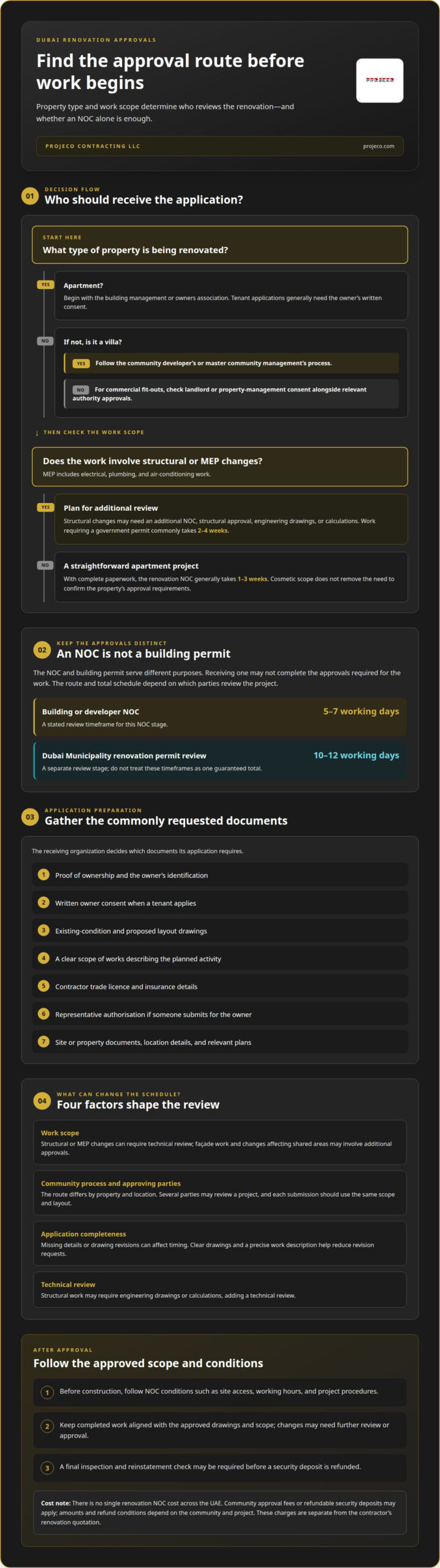
A renovation NOC can be only one part of the approval path. Getting a No Objection Certificate (NOC) for renovation in Dubai generally takes one to three weeks for a straightforward apartment project; work involving structural or MEP changes that requires a government permit commonly takes two to four weeks. The NOC and building permit serve different purposes, so receiving one may not complete the approvals needed for the work.
It’s understandable to want a clear timeline before planning a renovation. The schedule depends on the work’s scope, the community’s process, the number of approving parties, and whether the application is complete or needs drawing revisions.
This guide explains which organisation may issue the NOC for an apartment, villa, or commercial property, how an NOC relates to a building permit, and what can affect approval times. It also covers the documents commonly requested and why the approval route should be established before renovation work begins.
Key Takeaways
- Identify who controls renovation approvals for the property: an apartment building’s management or owners association, or the villa community’s developer or management.
- Prepare ownership and identification documents, existing and proposed plans, a clear scope of work, and contractor details for the application.
- Distinguish cosmetic updates from structural, electrical, plumbing, AC, or façade work, which may require additional approvals.
- Treat the NOC and building permit as separate approvals; some projects need both before work begins.
- Agree in writing who will manage the applications, and account for possible revisions, inspections, and reinstatement requirements.
How long does the approval process take for renovation permits in Dubai?
For owners, getting a No Objection Certificate (NOC) for renovation in Dubai generally takes one to three weeks for a straightforward apartment project with complete paperwork. Work requiring a government permit for structural or MEP changes commonly takes two to four weeks. A building or developer NOC may take five to seven working days, while Dubai Municipality reviews renovation permits within 10-12 working days. These are separate approval stages, so the total depends on the project’s route.
The receiving organisation and the work scope shape the application. A renovation professional identifies the property’s community, confirms the submission route, and prepares documents that reflect the proposed construction. Clear drawings and a precise scope can reduce revision requests. Structural changes may require engineering drawings or calculations, adding a technical review.
Commonly requested application documents include:
- Proof of ownership and the owner’s identification.
- Written owner consent when a tenant applies.
- Existing-condition and proposed layout drawings.
- A scope of works describing the planned activity.
- The contractor’s trade licence and insurance details.
- Representative authorisation when someone submits for the owner.
- Site or property documents, location details, and relevant plans.
The receiving authority determines which documents its application requires. Dubai Municipality applications are submitted online with project details and relevant drawings. A professional managing getting a No Objection Certificate (NOC) for renovation organises the materials, checks that the plans match the work description, and responds to revision requests. If several parties review the project, each submission should reflect the same scope and layout.
There is no single renovation NOC cost across the UAE. Some Dubai communities charge approval fees or require a refundable security deposit. The amount and refund conditions depend on the community and project. Authority or community charges are separate from the contractor’s renovation quotation.
After approval, the applicant must follow the NOC conditions before construction begins. These may cover site access, working hours, or other project procedures. After completion, a final inspection and reinstatement check may be required before a security deposit is refunded. Keeping the completed work aligned with the approved drawings and scope supports that inspection.
MOIAT’s digital platform concerns registration applications for conformity-assessment-body NOCs, not routine property renovation approvals. A Dubai property application instead follows the relevant community or municipality process. Distinguishing these routes helps prevent an unrelated registration service from being mistaken for the renovation approval channel.
Apartment, villa, and commercial renovation NOCs
A renovation NOC identifies the authority responsible for the property and the proposed work. In Dubai, the route differs for apartments, villas, and commercial fit-outs, so property type and scope matter.
NOCs for Apartments and Villas
For an apartment, the NOC generally comes from building management or the owners association. It records permission for the proposed work and may set conditions for access, working hours, or use of shared areas. Structured oversight is standard in regulated residential housing worldwide; for example, carrying out an hdb renovation in singapore involves similar mandatory clearances and strict submission guidelines before works can begin. Villa renovations usually follow the community developer’s or master community management’s process. Modifications affecting structural elements may require an additional NOC and structural approval.
A tenant generally needs the owner’s written consent before applying. Work affecting shared corridors, building services, or other common areas can also require society permission. These distinctions clarify whether the request concerns the private unit, the wider building, or the community.
NOC Granting Organizations
Start with the entity responsible for the property: building management or an owners association for an apartment, and the community developer or management for a villa. Dubai Municipality may issue an NOC for planned activities, including renovation or work affecting public areas. Its review can consider structural integrity, environmental impact, zoning compliance, and public safety.
Other approving parties may be involved, depending on the scope and location. A commercial fit-out or office modification may need property-management or landlord consent alongside relevant authority approvals. Discussing the proposed layout and scope helps identify which parties must provide written approval.
Common NOC Questions
Can a contractor apply on an owner’s behalf? Yes. In Dubai, an owner can generally authorise a contractor to submit a renovation NOC application when the documents are in order. The owner’s written authorisation clarifies who represents them during submission.
What should an issued NOC show? It should identify the issuing authority and recipient, describe the project and its purpose, give the issue date, and carry the authority’s signature and seal. The approved scope matters: changes to the proposed work may require further review or approval.
For commercial properties, property-related NOCs can apply to office fit-outs and other modifications requiring consent from a landlord, developer, or management company. The application should describe the proposed activity precisely, including whether the work changes the layout or affects shared areas. Dubai Municipality’s NOC review focuses on the scope of work, change of use, and applicable building rules.
Requirements vary by property and approving entity, rather than following one NOC for every project across the emirates. A renovation professional can coordinate the application route and keep the proposed scope consistent across submissions. Discuss your renovation approval needs as part of planning the project.
What happens if I start renovating without an NOC?
Starting work before obtaining approvals can expose a Dubai property owner to enforcement action and costly changes. The approval route depends on whether the work is cosmetic, structural, or affects utilities and shared areas.
Risks of Unapproved Renovation
Without required approval, a project may receive a stop-work notice, incur fines, or require completed work to be reversed. Fines can reach د.إ 50,000, depending on the violation. The consequences can extend beyond construction: unapproved alterations may create problems when the owner later sells or rents the property.
Painting a wall or replacing a fixture differs from removing a structural element or relocating plumbing. Before work begins, match the project scope to the community’s rules and relevant authority requirements. If an NOC application is rejected, address the stated concerns and resubmit it rather than proceeding without permission.
Utility and Building Approvals
Minor interior work, such as painting, fixture replacements, or cosmetic upgrades, often does not need a Dubai Municipality permit. However, some communities still require a minor-work permit. Structural changes, electrical upgrades, plumbing modifications, AC relocation, and façade work require official NOCs and permits.
Work affecting power, water, or cooling connections may also require utility coordination. DEWA may be relevant when electrical or water services are affected, but the required route depends on the work and property. Include this coordination in the approvals sequence rather than treating a building NOC as the only clearance.
Dubai’s authority route can vary by community. Dubai Municipality handles relevant municipal applications, while Trakhees is the permit authority for many freehold and free-zone communities, including Palm Jumeirah, Jebel Ali, Discovery Gardens, and International City. In free-zone communities, the Dubai Development Authority may issue authority approvals through the Trakheesi system.
Some developers or contractors also require a Dubai Municipality NOC before issuing their own approval. This can create a sequence: identify the controlling community, establish whether municipal or free-zone authority review applies, then submit the relevant documents and plans. The scope should clearly state whether the work changes structure, services, façade, or use.
For an apartment, community rules may also govern site access and permitted working hours. For a villa, the developer or master-community management may control the approval process. Shared-area work needs particular care because it can involve building or society permission in addition to approval for the unit’s renovation.
Approval coordination is most useful before demolition, installation, or service disconnection begins. A professional can map the required submissions against the work sequence and keep authority responses aligned with the proposed scope. Discuss renovation approval coordination before setting construction activities in motion.
How a renovation professional checks requirements with the receiving organization
A renovation professional establishes the approval route before finalising the work sequence. The property’s community, the proposed scope, and affected building systems determine which organisation must review the application.
Work That Usually Requires Approval
Start by classifying each proposed task rather than treating the renovation as one general activity. Painting or replacing fixtures may follow a different route from changing a layout, altering structural elements, or modifying plumbing. Work affecting shared areas also requires attention to building or community rules, even when the changes begin inside one property.
Owners and contractors should agree in writing on who manages each approval. This clarifies responsibility for submissions, revisions, and responses from the receiving organisation.
Next, match the project scope to the property’s approval process. Identify the controlling building management, owners association, developer, or authority, then confirm what each party reviews. For a Dubai Municipality application, organise the project details and relevant plans around the proposed activity.
- Define the scope: Separate cosmetic tasks from structural, service, façade, and shared-area work.
- Identify the recipient: Establish which community or authority controls the property and activity.
- Prepare consistent submissions: Align the work description and drawings across approval requests.
- Manage feedback: Record requested revisions and update affected documents before resubmission.
This sequence keeps the application focused. If an organisation requests a revised layout, update the corresponding plans and check that the written scope still describes the same work. Owners can then see which approval relates to each part of the renovation instead of assuming one permission covers every activity.
Work Types Requiring Formal Approval
Structural changes, electrical upgrades, plumbing modifications, AC relocation, and façade work may require official NOCs and permits. Similar to how exterior restoration specialists like progressivecontractingny.com navigate strict structural and preservation standards for historical building facades in New York, complex exterior alterations always demand careful compliance. A change of use can also bring additional authority review. Flag these elements early, as structural proposals may need technical drawings or calculations.
Dubai Municipality reviews relevant applications, while other authorities or developers may have separate requirements. Only licensed Dubai Municipality-approved contractors can submit renovation permit applications in Dubai. A contractor’s trade licence and insurance details may form part of the application documents.
For each submission, track the recipient, required documents, current drawing revision, and outstanding response. This is especially useful when building management and a government authority review different aspects. Each application should describe the same proposed work while clarifying which items affect structure, services, or use.
Owners gain a clear approval sequence before construction is scheduled. Matching each task to the right recipient and coordinating revisions helps reduce avoidable submission gaps and keeps the project aligned with the approved scope.
Relationship between a renovation NOC and a building permit
A renovation NOC and a building permit serve different approval roles in Dubai. The NOC records that a controlling entity, such as a developer or building management, has no objection to the proposed work. A government permit is a separate approval that may also be required, particularly for structural changes, extensions, or changes of use. Receiving one does not automatically mean the other has been issued.
The distinction matters because each approval addresses a different part of the project. A developer may assess work against community or building requirements, while a government authority considers the activity under its remit. For example, a villa extension may need the master community’s NOC and a government permit. A major apartment upgrade may require a Dubai Municipality NOC alongside a building permit.
Before submissions begin, the renovation professional maps the proposed work to the approvals involved:
- Community or building NOC: identifies the property controller’s position on the renovation scope.
- Government permit: may be required for structural changes, extensions, or a change of use.
- Dubai Municipality review: may apply to major renovations, changes of use, and upgrades to existing properties.
Drawings and the written scope should describe the same project at every stage. If a proposed layout shows a changed room arrangement but the application describes only cosmetic upgrades, reviewers may request clarification or revised drawings. A structural proposal may also require engineering drawings or calculations. Coordinating these materials helps each organisation assess the same defined work.
The approval sequence depends on the property, project scope, and number of reviewing parties. A developer or building management may need to issue its NOC before another approval proceeds, while some projects involve parallel reviews. Identify dependencies at the outset, submit aligned documents, and track requested revisions. Unclear scope or inconsistent drawings can cause delays because reviewers cannot reliably assess the same proposal.
The practical takeaway is straightforward: treat the NOC and permit as separate approvals, then confirm which apply before construction starts. A cosmetic refresh may follow a different route from an extension or structural alteration. For a major renovation, allow for each required review in the project schedule, not just the first NOC submission.
Discuss the approvals sequence for your renovation before finalising the construction programme.
Projeco Contracting LLC | Villa Construction | Apartment Interiors Fit Out
Projeco Contracting LLC | Villa Construction | Apartment Interiors Fit Out is a natural next step when renovation planning must align with property approval requirements. Its Home Renovation, Residential Interior, Villa Renovation, and Villa Fit Out services connect the planned transformation with the practical work needed to deliver it.
Turn to Projeco Contracting LLC when planning a home or villa renovation and developing a clear project scope to support discussions about NOCs and permits. The proposed layout, work description, and required approvals should correspond, especially when changes affect structural elements or building services. This alignment establishes a coherent basis for the renovation before work begins.
Contact Projeco Contracting LLC | Villa Construction | Apartment Interiors Fit Out to discuss your renovation plans.
Plan your renovation with the approvals in view
Make the approval process part of project planning, not a final administrative task. Before choosing finishes or scheduling construction, define the intended work in a clear brief that can guide design decisions, submissions, and delivery. A well-defined project helps keep the approved scope and finished result aligned.
Getting a No Objection Certificate (NOC) for renovation is one element of a broader property transformation. Projeco Contracting LLC | Villa Construction | Apartment Interiors Fit Out brings renovation and residential interior work together, helping owners connect their project vision with practical execution. Its home and villa renovation services make it a relevant next step for owners planning changes to their property.
Share your renovation plans and discuss a suitable way forward with Projeco Contracting LLC | Villa Construction | Apartment Interiors Fit Out. A considered start can make the next stage of your home’s transformation more purposeful.
Frequently Asked Questions
What Exactly is a No Objection Certificate?
For a Dubai renovation, an NOC can record the approved project scope and conditions attached to the work. It is not automatically a government building permit. For example, a building management NOC may cover renovation within an apartment, while a separate authority permit may apply to structural alterations.
Can a tenant get a renovation NOC, or only the owner?
A tenant can apply for a renovation NOC but generally needs the owner’s written consent. This establishes that the property owner authorises the proposed changes, while the application identifies the tenant or representative handling the request. For example, a tenant seeking permission to change a kitchen layout should document the owner’s approval alongside the renovation scope and plans before submitting an application.
Can my contractor apply on my behalf?
Yes, an owner can generally authorise a contractor to apply on their behalf in Dubai, provided the application documents are in order. The written authorisation should clearly support the contractor’s role in the submission. This arrangement can help coordinate technical plans and the work description while keeping the owner’s consent distinct from the contractor’s application tasks.
Can one company handle everything from NOC to project completion?
A design-and-build company can manage renovation work from design through construction when it provides turnkey project management. Projeco Contracting LLC offers home renovation and residential interior services, while the NOC process involves the relevant property manager or authority. Its project team can coordinate renovation planning and delivery, with the approval route determined by the property and organisations reviewing the proposed work.
Do I need a permit or NOC for painting or light renovations?
Painting and other minor cosmetic upgrades often do not require a Dubai Municipality permit, but some communities require a minor-work permit. A building or community may set its own access and work conditions even for simple interior changes. Replacing a fixture differs from moving plumbing or altering electrical services, which can trigger additional approval requirements.
How long does approval take?
A straightforward apartment renovation with complete paperwork generally takes one to three weeks for approvals. Structural or MEP work requiring a government permit commonly takes two to four weeks. The schedule depends on the community’s process, submission completeness, drawing revisions, project scope, and number of reviewing parties. A municipality technical review can add time when the activity requires closer assessment.
What Is a NOC?
An NOC is a formal statement that its issuer has no objection to a defined activity. For a property renovation, the issuer is commonly the entity controlling the building or community. The document should identify the authority, recipient, project details, purpose, issue date, and authorised signature and seal. Its permission relates to the stated project, so a materially changed scope may need further review.
What is a Dubai Municipality NOC?
A Dubai Municipality NOC is official confirmation that the municipality has no objection to a planned activity, such as renovation or work affecting public areas. The application includes project details and relevant plans, and the scope of work frames the review. Municipality approval is distinct from a developer or building-management NOC, so a renovation may involve more than one approval route.