

What if the biggest risk to a premium commercial interior isn’t the design, but the gaps between the people delivering it? An upscale commercial interior coordination Dubai project can involve designers, contractors, suppliers, building management and approval authorities. If decision-making and hand-offs are unclear, the design can lose consistency, while rework or delays can affect the finished space. A successful result needs more than striking materials and visual impact. It must also support the way the venue operates.
Choosing a coordination partner can be difficult when providers describe different scopes. Look beyond the design presentation and ask who will connect the brief to approvals, procurement, site delivery and operational needs. This guide explains what effective coordination should cover and how to compare providers for an office, retail space or F&B venue. Use the questions throughout to clarify accountability, assess relevant experience and prepare for a focused discussion with a potential Dubai partner.
Key Takeaways
- Define who owns decisions, coordination and contractor interfaces before work begins, so hand-offs are clear.
- Compare providers on scope, communication, technical coordination and delivery approach, not portfolio imagery alone.
- Ask project-specific questions to find out whether a partner understands your venue’s operational needs as well as its design ambitions.
- For upscale commercial interior coordination Dubai, confirm which approvals and building-management requirements apply to your property and location.
- Prepare for an initial discussion with your project type, location, objectives and known constraints.
Why upscale commercial interior coordination in Dubai shapes the finished space
A premium commercial interior has to do more than make a strong first impression. It should express the brand and support the work that happens there, from welcoming customers to helping staff move efficiently through the space. That balance depends on decisions being coordinated rather than made in isolation.
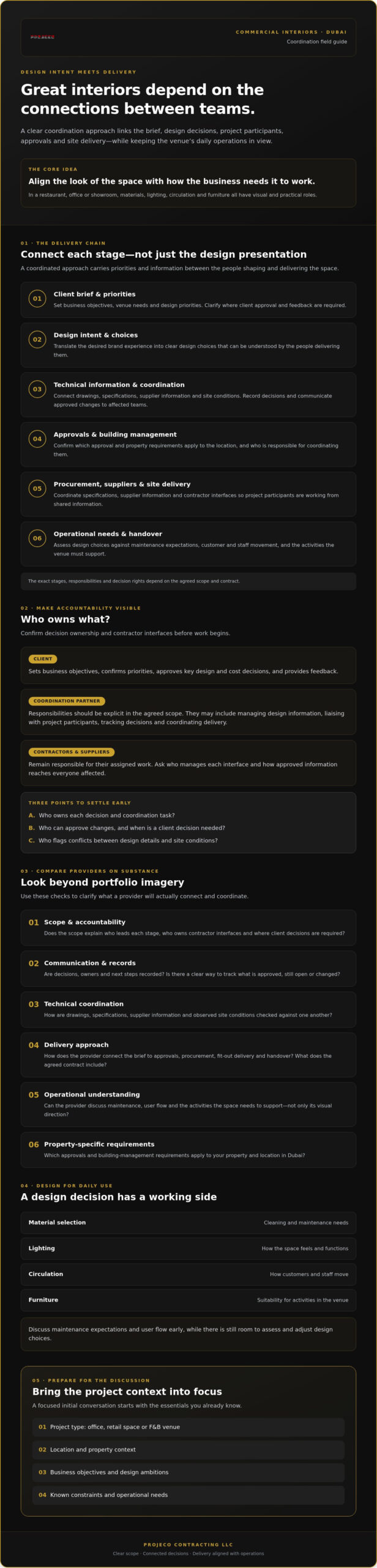
Commercial interior coordination is the process of aligning design intent, technical decisions, project participants and operational needs to deliver a coherent, functional space. In practice, it means connecting the client’s priorities and design choices with specifications, site activities and the venue’s requirements.
Coordination is different from interior design alone, which may focus on the concept and visual direction, and from construction execution alone, which focuses on carrying out the work. A coordinated delivery approach links these stages and clarifies how information and decisions pass between the client, designers, contractors and suppliers. In a design-and-build arrangement, one entity may take responsibility for both design and construction. The single point of responsibility contract model can help clarify accountability, subject to the agreed scope and contract.
If you’re considering commercial fit-out in Dubai, ask how a provider’s design-and-build or fit-out approach connects the intended customer experience to practical delivery. Appearance matters, but it should not be the only measure of success.
What does commercial interior coordination include?
Coordination connects design choices with the information needed to deliver them, including specifications, technical decisions, site activities and client priorities. For example, a material choice should be documented clearly enough for the relevant project participants to understand what is intended and how it fits the wider scheme. Clear, shared information can help reduce conflicting instructions and avoidable rework. Exact responsibilities, decision rights and contractor interfaces depend on the agreed scope and contract, so confirm them before work begins.
Why upscale projects need design and operational alignment
In a restaurant, office or showroom, finishes and spatial choices have a practical purpose as well as a visual one. Material selection affects cleaning needs; lighting shapes how a space feels and functions; circulation influences how customers and staff move; and furniture should suit the activities taking place. Discuss maintenance expectations and user flow early, so the team can assess design choices against daily use while there is still room to adjust them.
That is the practical value of upscale commercial interior coordination Dubai: it brings brand expression and operational requirements into the same conversation, helping shape a considered environment that suits the business it serves.
Which responsibilities should your Dubai interior coordination partner own?
Before appointing a partner, establish who leads each stage and where client decisions are needed. A clear scope should trace the project from brief development and design coordination through fit-out delivery and handover. Integrated design-and-build can bring design and construction into one delivery structure, while other arrangements may divide these roles. The contract should state which approach applies.
The client typically sets business objectives, confirms priorities, approves key design and cost decisions, and provides feedback. The coordination partner’s responsibilities should be defined in the agreed scope. They may include managing design information, liaising with project participants, tracking decisions and coordinating delivery. Contractors and suppliers remain responsible for their assigned work. Ask who manages each interface, who can approve changes and who will flag when a decision is needed.
How design, technical information, and site teams connect
Drawings, specifications, supplier information and observed site conditions need to be checked against one another. If a proposed finish, fitting or layout conflicts with site conditions, ask who will identify the issue, coordinate a resolution and communicate the approved change to everyone affected. This is especially important when design details meet fit-out work: an unshared revision can leave teams working from different instructions.
Look for a simple, consistent record-keeping process. Meeting notes should capture decisions, owners and next steps. A decision log should show what has been approved and what remains open. Change tracking should record what changed and who needs the updated information. These records provide a useful decision trail for quality checks and hand-offs, instead of relying on informal conversations.
How coordination protects business operations
Include the operating brief in the coordination scope from the start. Discuss the intended opening plan, staff circulation, customer experience and maintenance needs, then ask how those priorities will inform the layout and delivery sequence. For hospitality projects, consider service flow, kitchen interfaces and the relationship between working areas and customer zones. A provider with commercial, office and F&B fit-out capabilities may be able to discuss these operational considerations alongside the visual brief.
As you assess upscale commercial interior coordination Dubai providers, ask how they would handle responsibilities, changes and operational requirements for your project. Projeco Contracting LLC offers commercial and office fit-out, specialised F&B fit-out, and integrated design-and-build services. You can discuss your commercial project with Projeco Contracting LLC | Villa Construction | Apartment Interiors Fit Out to clarify its scope and coordination needs.
How to compare upscale commercial interior coordination providers
A polished portfolio can show visual ambition, but it won’t tell you how a provider manages interfaces or responds when plans meet site conditions. For upscale commercial interior coordination Dubai, compare the proposed process as carefully as the finished imagery. Focus on how the provider defines responsibilities, communicates decisions and carries design intent through delivery.
| Comparison area | What to clarify | What useful evidence looks like |
|---|---|---|
| Scope | Which stages and interfaces are included, and what is excluded? | A written scope that identifies responsibilities, client decisions and contractor interfaces. |
| Communication | Who is your main contact, how often will updates be shared, and how can issues be escalated? | A defined communication cadence and a clear route for unresolved decisions. |
| Technical coordination | How are drawings, specifications, supplier information and site queries aligned? | A process for recording revisions and sharing approved information with affected parties. |
| Delivery approach | How does the team carry design intent through fit-out and handover? | A coherent explanation of how design, site activities and hand-offs connect. |
Questions to ask before appointing a coordination partner
Ask who leads coordination and who is accountable at each project interface. Then test the process with practical scenarios. If a site condition conflicts with a drawing, who resolves it? If the scope changes, how is the impact recorded and approved? Ask how client decisions, approvals and site issues are documented. Clarify inclusions, exclusions, update frequency and escalation routes. Specific answers help distinguish a defined delivery method from broad assurances.
Ask the provider to describe a coordination challenge and explain what decision was needed, how it was recorded, who was informed and how the resolution was confirmed. The aim isn’t to expect every project to follow the same path. It’s to understand whether the provider can explain its process clearly and show how accountability is maintained.
How to assess portfolio relevance and delivery approach
Look for experience that matches your venue type, scale and operational requirements. Offices, showrooms and restaurants place different demands on layouts and delivery, so attractive images alone may not establish relevance. Ask how the team carried design intent into material choices, detailing and site execution, and what information it can share to support the discussion.
When reviewing a provider’s work, ask how each example relates to your venue type and project needs. Treat examples as a prompt to verify relevance, not automatic proof of results. If references or further project information are offered, clarify what they demonstrate and whether the experience applies to your brief. A measured comparison helps you shortlist on scope, communication, technical coordination and delivery approach, not presentation alone.
How to coordinate approvals, stakeholders, and site delivery in Dubai
Commercial fit-out coordination in Dubai should account for the property, its location and the intended use of the space. Applicable authorities and building-management requirements can differ between projects, so treat any workflow as a planning framework, not a fixed approval sequence. Confirm the relevant route with the project parties before relying on dates or starting work.
A practical coordination sequence for commercial interiors
Agree on a sequence that keeps decisions, technical information and delivery connected. Confirm the order and responsibilities for the specific project.
- Validate the brief. Confirm the venue’s operations, property constraints, project objectives, decision-makers and agreed scope. Record assumptions that still need to be checked.
- Map stakeholders and requirements. Identify the landlord or building management, relevant authorities, design and fit-out teams, suppliers, and the people responsible for decisions and submissions.
- Coordinate design and technical information. Check drawings and specifications against site conditions and relevant technical inputs before procurement or site implementation. Resolve open questions and share approved revisions with affected parties.
- Plan site delivery. Agree how progress, dependencies, changes and site issues will be recorded, communicated and escalated. Keep responsibility for each interface clear.
- Prepare for handover. Confirm what completion information, records and outstanding items the client expects, and who is responsible for assembling and reviewing them.
These steps give an upscale commercial interior coordination Dubai team a practical framework for managing the project without assuming that every property follows the same process.
What to verify before work begins
Confirm which authority, landlord, building-management and fire-safety requirements apply to the specific site. Depending on the location and property, the relevant parties to check may include Dubai Municipality, Dubai Civil Defence, Trakhees or the Dubai Development Authority. Verify whether they apply to the project rather than relying on a general checklist.
Ask the appointed project parties to clarify who is responsible for confirming requirements, preparing and submitting information, responding to comments, and communicating any resulting changes to the design or delivery plan. Check expected review timing directly with those parties, and account for dependencies in the project programme without treating an indicative timeframe as confirmation.
Requirements can differ across Dubai jurisdictions and property developments. A site within a managed development may also have its own procedures, so confirm how those relate to any authority process. Keep clear records of decisions, submissions and revisions so the client and delivery team can stay aligned as the project progresses.
To discuss your brief, location and coordination requirements, contact Projeco Contracting LLC | Villa Construction | Apartment Interiors Fit Out.
Choose an upscale commercial interior coordination partner with confidence
A confident choice comes down to more than an impressive presentation. Shortlist providers who can explain how they maintain accountability, demonstrate experience relevant to your venue, communicate decisions clearly and understand how the space needs to operate. For upscale commercial interior coordination Dubai, look for a delivery approach that connects design decisions with fit-out work and a defined handover, rather than leaving important interfaces unclear.
Prepare a clear brief for an initial project discussion
Bring together the essentials: property location, venue type, intended use and the project scope you’re considering. Note operational priorities, design references, known property constraints and who will make or approve key decisions. You don’t need every technical answer before the first conversation. Ask the provider what information is still needed to define responsibilities, assess interfaces and shape a suitable scope.
- What should the space enable for customers, staff or other users?
- Which site, building-management or timing constraints are already known?
- Who will provide approvals and decisions, and how will open items be tracked?
What a well-scoped next step should clarify
A useful next step should set out the proposed service scope, client inputs, project interfaces and communication process. Clarify how design coordination connects with fit-out delivery, how changes are handled and what information is expected for handover. This gives both sides a shared basis for discussing responsibilities before assumptions become part of the project plan.
Projeco Contracting LLC | Villa Construction | Apartment Interiors Fit Out is a Dubai-based design-and-build firm offering commercial and office fit-out, specialised F&B fit-out and turnkey project services. Its integrated approach can connect design and delivery within one project structure, with responsibilities shaped by the agreed scope. Ask how its fit-out capabilities and delivery approach relate to your venue and project requirements.
Use your brief to begin a focused conversation about the property, objectives and constraints. You can discuss your commercial interior project and clarify what information would help define the next step.
Contact Projeco to discuss your project
Move your commercial interior brief forward with clarity
The right partner should make responsibilities visible, connect design decisions with fit-out delivery and understand how your venue needs to function. Compare providers on relevant commercial experience and communication, then confirm the project scope and applicable property or authority requirements before work proceeds. These steps help turn uncertainty into a more structured discussion.
For upscale commercial interior coordination Dubai, an integrated design-and-build approach can clarify hand-offs by connecting design and delivery within an agreed scope. Projeco Contracting LLC is a Dubai-based firm with UAE-wide coverage, commercial and office fit-out capabilities, and integrated design-and-build and turnkey project services.
Bring your venue type, property location, objectives and known constraints to the first conversation. Discuss your commercial interior project with Projeco and explore a clear, project-specific next step. With a considered brief and defined responsibilities, you can move towards a refined space that supports both your brand and daily operations.
Frequently Asked Questions
How do I choose a commercial interior coordination company in Dubai?
Compare providers on defined scope, accountability, communication, technical coordination and experience relevant to your venue type. For upscale commercial interior coordination Dubai, ask how the provider connects design intent with fit-out delivery and operational requirements, not just what its portfolio looks like. Ask how challenges are handled and how project decisions and changes are documented. Check that the proposed approach suits your property and intended use.
Is interior coordination the same as interior design or fit-out?
No. Interior design develops the space’s concept and design direction, while fit-out involves delivering the physical interior work. Coordination connects the information, decisions and people involved across those activities so the intended design can be carried through to site delivery. A provider may offer one or more of these services, so don’t assume design, coordination and construction are all included. Review the written scope and interfaces before appointment.
What should I ask a commercial interior coordinator before hiring them?
Ask who leads coordination, which responsibilities are included and who remains accountable for each contractor or supplier interface. Confirm how client decisions, approvals, scope changes and site issues will be recorded and communicated. Clarify the expected update cadence, escalation route, inclusions and exclusions, and what handover information is provided. A useful discussion should make clear what the provider needs from you and which project details remain to be verified.
How do Dubai approvals affect a commercial interior fit-out?
Approval requirements depend on the project’s location, property type and building, so confirm them for the specific site rather than assuming a standard sequence. The relevant parties to check may include the landlord or building management and, where applicable, Dubai Municipality, Dubai Civil Defence, Trakhees or the Dubai Development Authority. Ask qualified project parties to verify requirements, submission responsibilities and review timing before planning work around them.
Can one company manage both design and commercial fit-out coordination?
Yes, a design-and-build company can bring design and fit-out delivery together, subject to its agreed scope and project arrangements. This may help clarify hand-offs by giving the client a connected point of responsibility across those stages. Projeco Contracting LLC provides integrated design-and-build and turnkey project services, alongside commercial and office fit-out capabilities. Ask which design, coordination, site-delivery and handover responsibilities are included for your project.
What information should I prepare before requesting a commercial interior proposal?
Prepare the property location, venue type, intended use and the scope you’re considering, such as a commercial or office fit-out. Include operational priorities, design references, known site or building constraints, target milestones if established, and the names or roles of key decision-makers. You don’t need every technical answer at the outset. Ask the provider what additional information is needed to define responsibilities, interfaces and a suitable proposal.