

The contract’s title won’t tell you where the main risks sit. To understand how to read a construction contract in Dubai, first identify its form: FIDIC 1999 Red, Yellow and Silver Books are common standard forms, alongside EPC and Design & Build agreements, main contracts, subcontracts and project-linked supply agreements. The amendments and appendices matter as much as the form itself.
It’s easy to focus on price and scope, but clauses on delivery, changes, delays, liability, insurance and payment determine how a project works in practice. Review how these terms fit together rather than considering each in isolation.
This guide explains how to recognise common contract structures used in Dubai and the UAE, then assess who is responsible for design and construction, how variations and delays are handled, and what the liability, insurance and payment wording means. You’ll also learn why document hierarchy and dispute-resolution terms deserve close attention before signing. The aim is a more informed view of the commitments, risks and practical obligations set out in the agreement.
Key Takeaways
- Read the governing-law, jurisdiction and dispute-escalation clauses together so you understand how a disagreement may proceed and which notices matter.
- Compare design-build and design-bid-build arrangements by identifying who carries design responsibility and how that allocation affects coordination and accountability.
- Review liability, indemnities, warranties and insurance against each party’s actual project responsibilities, with particular attention to structural-defect obligations.
- Trace the payment process from application and certification to retention, set-off and release conditions to see where cash-flow disputes can arise.
- Look beyond the contract’s title: amendments, appendices and document-priority rules can materially change how a standard form operates.
Dispute resolution, governing law and jurisdiction
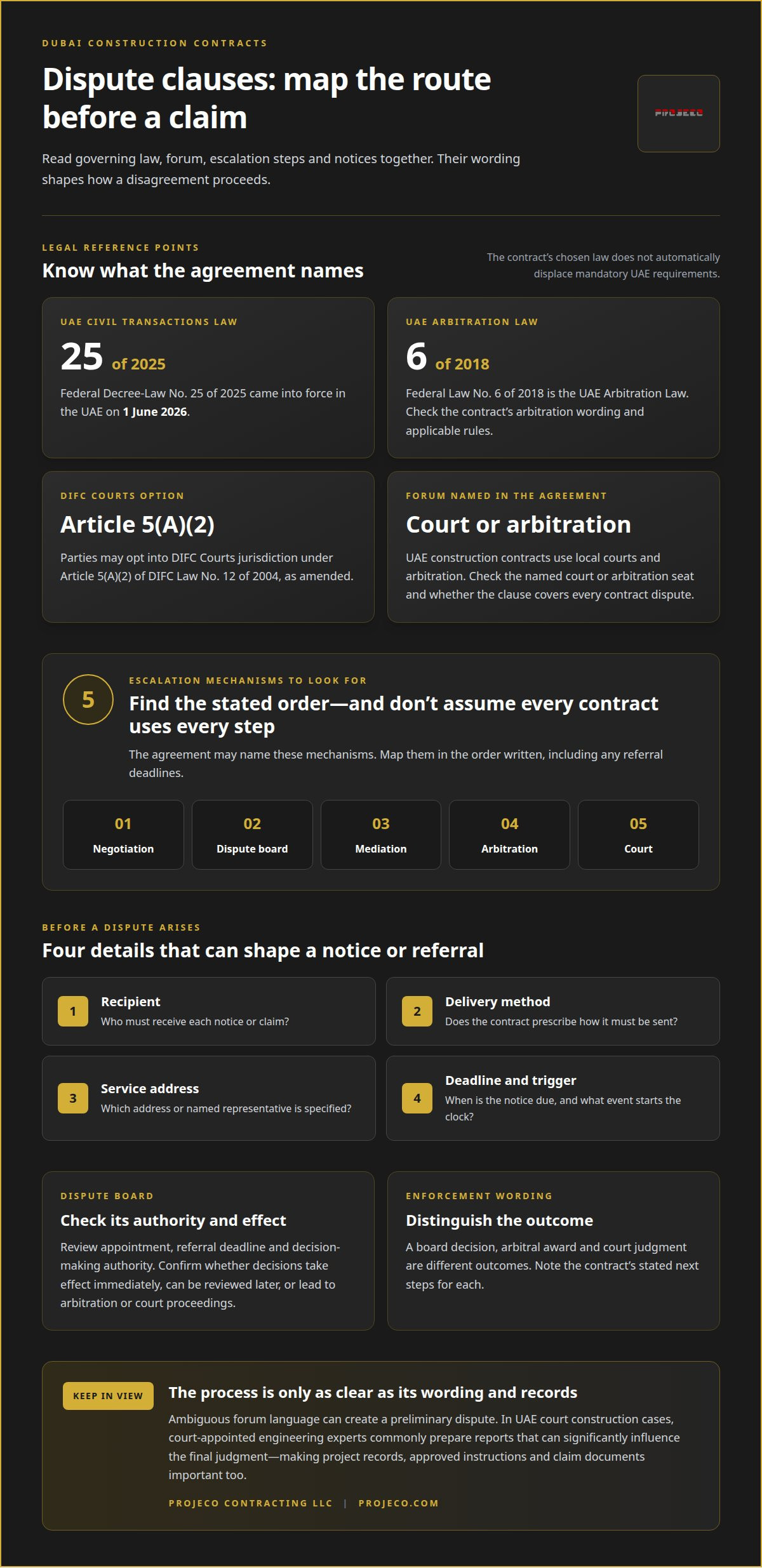
Read the governing-law clause alongside the dispute-resolution clause; together, they shape how a construction disagreement proceeds. Federal Decree-Law No. 25 of 2025, identified as the UAE Civil Transactions Law, came into force in the UAE on 1 June 2026. UAE construction agreements may set their terms freely, subject to mandatory provisions of that law and other applicable legislation. A clause choosing another governing law does not automatically remove those mandatory requirements.
Identify the forum named in the agreement. UAE construction contracts use arbitration and local courts, while parties may opt into DIFC Courts jurisdiction under Article 5(A)(2) of DIFC Law No. 12 of 2004, as amended. The UAE Arbitration Law is Federal Law No. 6 of 2018. Check whether arbitration is mandatory, how an arbitrator is appointed, where proceedings are seated, and which rules apply. Ambiguous wording can create a preliminary dispute about the correct forum before the underlying claim is heard.
Some agreements provide for a dispute board to address project issues as they arise. Check how it is appointed, what authority it has, the deadline for referrals and the effect of its decisions. The contract should state whether decisions take effect immediately, can be reviewed later, or lead to arbitration or court proceedings. For example, a disagreement over a delayed instruction may have to be referred within a set contractual period before another forum can consider it.
- Map escalation: identify negotiation, dispute-board referral, mediation, arbitration or court stages, in their stated order.
- Track notices: note the required recipient, delivery method, service address and deadline for each claim or referral.
- Read enforcement wording: distinguish a board decision, arbitral award and court judgment, then note the contract’s stated next steps.
- Check jurisdiction: confirm the named court or arbitration seat and whether the clause covers every contract dispute.
Notice requirements can affect a claim even when its technical basis appears strong. Check whether the contract requires written notice, supporting details, a specific delivery method or service on a named representative. Keep correspondence, instructions and project records in the required form. Missing an escalation step can complicate later proceedings, so note each deadline and the event that triggers it.
In UAE court construction cases, court-appointed engineering experts commonly prepare reports that can significantly influence the final judgment. Project records, approved instructions and claim documents may therefore matter as much as the contract wording. Before signing, trace how a variation, delay or payment dispute moves from notice to resolution. This is a practical way to understand how to read a construction contract in Dubai, including its forum, governing law and enforcement route.
Design-bid-build and design-build contracts
In design-bid-build, the employer typically hires design professionals before appointing a contractor to build from the completed design. In design-build, one contractor is responsible for both design and construction under a single agreement. This can improve communication between designer and builder and reduce the risk of disputes between them. The contract must still define the scope, review process and approval authority.
In Dubai, the written agreement should allocate responsibility for permits, utility connections, insurance, and health and safety among the employer, contractor and any specialists. Allocations vary by project and remain subject to applicable statutory obligations.
For design-bid-build, check whether the employer’s design documents are complete enough to price and build from. Identify who coordinates specialist designs, answers technical queries and approves changes. If a villa drawing shows one finish but the specification describes another, the contract’s document hierarchy and approval process determine how to resolve the conflict. Don’t assume the contractor is responsible for design simply because it must build to the drawings.
For design-build, define the employer’s requirements precisely, including performance, quality, materials, interfaces and approval milestones. The contract should explain how design submissions are reviewed, who can issue instructions and whether approval changes responsibility. If a specialist’s design affects the main contractor’s coordination, for example, specify who must integrate and check that interface.
Building and fire safety obligations need their own clear treatment. Law No. 4 of 2025 established the DCD General Command and reinforced fire safety and emergency preparedness requirements in the UAE. The contract should identify the party responsible for coordinating fire-safety design, specialist input, submissions and implementation, alongside the project’s applicable requirements. It should also describe how changes affecting safety systems are documented and approved.
- Design responsibility: distinguish the employer’s design from contractor-designed elements and specialist packages.
- Permits and connections: name who prepares submissions, secures approvals and coordinates utility interfaces.
- Insurance and safety: state required cover, responsible parties, site procedures and reporting obligations.
- Approvals: set review periods and clarify whether approval affects design responsibility.
For a Dubai project using a single design-and-construction arrangement, discuss your design-and-build project alongside the scope and responsibility matrix. Clear allocation helps the parties understand who delivers each design element and how statutory obligations connect to project duties.
Liability, indemnities, warranties and insurance
Liability clauses allocate responsibility for loss, while insurance clauses address financial protection against defined risks. Review both alongside warranties and the contract’s provisions for defects.
Liability and Indemnities
Liability provisions state which losses a party must bear. Indemnities require one party to compensate another for specified claims or costs. Their wording matters: broad clauses can shift exposure beyond the work or risks a party controls.
Review liability caps, exclusions, indemnity triggers and the claims covered. For example, assess an indemnity for damage caused by a specialist’s work against the party’s actual ability to supervise that work. Check that variations, subcontracted activities and third-party claims are treated consistently across the relevant clauses.
Defects, Warranties, and Decennial Liability
Warranties set out contractual promises about work or materials; defects clauses explain how to identify and remedy non-compliant work. These terms matter because practical completion may trigger a defects liability period, release of retention where applicable, and statutory obligations.
Under Article 880 of the UAE Civil Transactions Law, contractors and architects may be jointly liable for 10 years following project completion for qualifying collapse or serious structural defects. Keep this decennial liability distinct from a contractual warranty: they arise on different bases and may cover different issues.
Insurance wording should reflect the project’s risks and each party’s responsibilities. Review the required policies, insured parties, coverage periods, exclusions, limits and evidence requirements, then compare them with the indemnities. If a party accepts liability for a risk excluded from its policy, that exposure may be uninsured.
Check how the agreement addresses damage, injury, defective work and third-party claims. Confirm who must notify insurers, preserve evidence and manage a claim, and whether settlement requires another party’s consent. A clause requiring insurance does not explain how a claim will be handled; the contract and policy wording need to work together.
- Match responsibility: connect each indemnity to the work, people or risks the indemnifying party controls.
- Compare limits: assess liability caps and insurance limits against the obligations they are meant to support.
- Separate obligations: distinguish contractual defect remedies from statutory decennial liability.
- Check completion effects: identify how practical completion affects defect periods, retention and ongoing responsibilities.
For a qualifying structural defect, the statutory period runs for 10 years following project completion under Article 880. The contract’s completion definition, handover records and defect-notification process therefore matter. Review whether the documents clearly record completion and distinguish ordinary defects from serious structural issues. These details help parties understand which obligations continue after handover and how a claim should be documented.
Progress-payment applications and certification
Review clauses on scope, payment applications, certification, retention, set-off, notices, suspension and termination. Each payment milestone should define the work that earns payment. The agreement should also state any advance-payment terms and how VAT is treated on invoices.
Retention, Set-Off, and Payment Timelines
These clauses explain when an application is assessed, what amounts may be withheld and when payment falls due. Certification delays, deductions and retention can all affect project cash flow.
For UAE projects, 14 to 21 days is described as emerging market practice for certifying or giving a reasoned rejection of payment applications. A construction contract commonly provides for payment within 28 days after certification. Retention is typically 5-10% of interim payments. Read the trigger for release, including whether release depends on practical completion, the defects period or another stated milestone.
Set-off wording should identify which sums may be deducted, the basis for each deduction and the required notice. If the employer disputes part of an application, for example, the contract should say whether the undisputed balance remains payable. Align the application format, supporting records and certification process with the work sequence. Where the contract requires a detailed valuation, progress records and approved variations can support the claimed amount.
Payment Milestones, Advances, and VAT
Milestones tie payment to defined deliverables, while advance-payment terms cover payment before the corresponding work is complete. Vague triggers can leave the parties disputing whether payment is due.
For each milestone, specify the deliverable, evidence of completion, reviewer and certification trigger. State whether an advance is recovered from later applications and how repayment is calculated. The agreement should also say whether VAT is included in stated sums or added to invoices, and identify the required invoicing documents. Clear terms make the payment calculation easier to follow without assuming a tax treatment that the contract does not specify.
Non-payment clauses need equal care. One model clause permits suspension when a certified sum remains unpaid for more than 42 days, after 14 days’ written notice. It allows termination if non-payment continues for a further 28 days after the suspension notice. These are model terms, not a universal rule. A separate example gives 56 days as a threshold for termination when non-payment persists.
Before taking action, follow the agreement’s notice method, cure period and escalation sequence. Check whether suspension changes the completion timetable, affects payment for work performed, or requires protection of materials left on site. Courts may consider the contract wording and project records if a payment dispute proceeds. For a project with milestone-based applications, discuss the payment structure alongside its scope and certification process.
Construction contract types reviewed in Dubai and the UAE
Dubai and UAE construction agreements include EPC and Design & Build contracts, FIDIC-style forms and amendments, main contracts, subcontracts, project-linked supply agreements and appendices. To verify contractor licensing and authority approvals in Dubai, establish which party must hold the relevant registration or classification and secure each project approval. Dubai Law No. 7 of 2025 introduced a unified registration and contractor classification framework across Dubai, including free zones.
The form sets the starting structure, but amendments and appendices can materially change its effect. FIDIC 1999 Red, Yellow and Silver Books are described as primary standard construction forms in the UAE. Identify the chosen book, then read its particular conditions, schedules and scope documents alongside the general conditions. A FIDIC title alone does not reveal which clauses the parties changed or which document governs a conflict.
Price mechanisms allocate uncertainty differently. A fixed-price contract keeps the agreed project price constant unless the scope changes significantly. It can suit a clearly defined scope with minimal design risk, but the contractor may absorb costs above its initial budget. Cost-plus terms reimburse legitimate project costs and add an agreed fee; there may be no maximum total cost. The client’s expense tracking and approval process is therefore central.
Time-and-materials terms calculate payment from the contractor’s time and materials used. Costs can rise if the work takes longer than expected, so the contract should clarify records, rates and approval for additional work. This approach can suit small projects, maintenance, renovations and repairs. A unit-price contract sets a price for each work unit, with the final total depending on completed quantities. It can suit projects with many tasks and uncertain quantities.
Use separate related agreements only when their interfaces are clear. A subcontract may pass main-contract obligations downstream, while a project-linked supply agreement can affect delivery and installation sequencing. Check that scope, technical specifications, completion dates and notice duties align across the documents. If the main contract changes, assess whether the subcontract or supply terms need to change too.
Document priority matters when drawings, specifications and schedules conflict. The contract should set out their hierarchy so the parties know which requirement takes precedence. A construction joint venture is different from a simple subcontract: its parties share business risks, profits and obligations. For large or complex projects, this structure can combine resources and specialist expertise, but the agreement should define each party’s authority and responsibilities.
- Identify the form: distinguish FIDIC, EPC, Design & Build and other contract structures.
- Trace price risk: compare fixed-price, cost-plus, time-and-materials and unit-price mechanisms.
- Align documents: review amendments, appendices, scope, completion requirements and document priority.
For a Dubai project, discuss your construction project and how its scope and delivery structure fit together.
Projeco Contracting LLC | Villa Construction | Apartment Interiors Fit Out
Projeco Contracting LLC | Villa Construction | Apartment Interiors Fit Out can help shape a residential project brief into clearly defined renovation and fit-out work. If you’re planning a home renovation, villa renovation, villa fit out or residential interior project, involve the construction team as you align the scope, responsibilities and delivery expectations.
A clearly defined scope supports focused discussions about the work, approvals, materials, changes and completion requirements. Projeco’s residential services are a practical next step once your contract review has clarified the project type and you’re ready to discuss its execution. For legal interpretation of disputed clauses, consult a qualified legal professional.
Contact Projeco Contracting LLC | Villa Construction | Apartment Interiors Fit Out to discuss your residential project.
Turn Contract Clarity into a Strong Project Brief
Knowing how to read a construction contract in Dubai helps you turn signed terms into a considered project brief. Use that clarity to define the intended result, included work and decisions to make before delivery begins. A coherent brief gives the project team a shared reference point as plans develop.
For a residential project, connect your priorities with the work you want completed. Projeco Contracting LLC | Villa Construction | Apartment Interiors Fit Out can discuss how its renovation and interior services relate to your project scope. This is a practical conversation about the intended result and work involved, not a substitute for legal advice on disputed contract wording.
Discuss your project with Projeco Contracting LLC | Villa Construction | Apartment Interiors Fit Out, and take the next step with a clearer brief and a considered plan.
Frequently Asked Questions
3.10 Is the contractor ever entitled to suspend works?
Yes, a contractor may suspend work when the contract grants that right and its conditions are met. One model UAE clause permits suspension if a certified amount remains unpaid for more than 42 days, after 14 days’ written notice. This is an example, not a universal entitlement. Check the agreement’s trigger, notice delivery requirements, cure period and consequences for completion dates before suspending.
3.18 Where the terms of a construction contract are ambiguous, are there rules that will settle how that ambiguity is interpreted?
First, look for the contract’s document-priority clause, which states which document prevails if provisions conflict. Drawings, specifications, schedules and amendments may set different requirements, so the stated hierarchy can guide interpretation. A 2016 construction dispute described document priority being used to resolve ambiguity. Keep the signed documents and approved revisions together, since a later amendment may change which requirement controls.
What Is Construction Law in the UAE?
Construction law in the UAE is the legal framework governing construction agreements, project obligations, liability, disputes and remedies. Construction contracts fall within the UAE Civil Transactions Law’s rules for contracts for work. Federal Decree-Law No. 25 of 2025, identified as the UAE Civil Transactions Law, came into force on 1 June 2026. Arbitration is separately governed by Federal Law No. 6 of 2018.
What is a variation order?
A variation order is a formal instruction or agreement changing the work, its specification, quantity or other contracted requirement. Under FIDIC, Clause 13 covers variations and adjustments. For example, changing a specified finish can affect valuation and completion time. The contract should identify who may approve the change, the required written notice, how its price is calculated and how any time impact is assessed.
What construction contract types are commonly used in Dubai, such as FIDIC and bespoke contracts?
Common forms include FIDIC-style contracts, EPC and Design & Build agreements, bespoke contracts, main contracts, subcontracts and project-linked supply agreements. FIDIC 1999 Red, Yellow and Silver Books are described as primary standard forms in the UAE. A bespoke agreement is drafted for its project’s arrangements. In either case, review amendments, appendices and document priority, since these can change how the chosen form operates.
Which UAE and Dubai laws govern construction contracts and disputes?
The governing framework depends on the contract’s governing-law and dispute-resolution clauses, alongside mandatory applicable legislation. Federal Decree-Law No. 25 of 2025 is identified as the UAE Civil Transactions Law and took effect on 1 June 2026. Federal Law No. 6 of 2018 governs arbitration. In Dubai, Dubai Law No. 7 of 2025 introduced a unified contractor registration and classification framework, including free zones.
What should a Dubai construction contract say about scope, drawings, specifications, and variations?
The contract should define the work, identify the governing drawings and specifications, and state which document prevails if requirements conflict. It should also specify who can instruct a variation, what makes an instruction valid, how the change is valued and how its effect on time is assessed. For example, link a revised drawing to an approved instruction and explain its corresponding price and schedule treatment.
What are typical construction timelines, liquidated damages, and extension-of-time provisions in Dubai?
Timelines and extension-of-time rights depend on the agreed programme, qualifying delay events, proof requirements and notice deadlines. Review concurrency wording and how liquidated damages are allocated. Contract guidance recommends an overall liquidated-damages cap of 5-10% of the contract price and a 14-day cure period before damages accrue. Treat these as drafting recommendations, not automatic UAE-wide rules; the signed terms determine the agreed process.